Matrix is the gold standard for decentralized, end-to-end encrypted communication. It powers government messaging systems, open-source communities, and privacy-focused organizations worldwide.
For the individual developer, however, the appeal is often closer to home: bridging fragmented chat networks (like Discord and Slack) into a single inbox, or simply ensuring your conversation history lives on infrastructure you control. Functionally, Matrix operates as a decentralized, eventually consistent state machine. Instead of a central server pushing updates, homeservers exchange signed JSON events over HTTP, using a conflict resolution algorithm to merge these streams into a unified view of the room’s history.
But there is a “tax” to running it
Traditionally, operating a Matrix homeserver has meant accepting a heavy operational burden. You aren’t just installing software; you are becoming a system administrator. You have to provision virtual private servers (VPS), tune PostgreSQL for heavy write loads, manage Redis for caching, configure reverse proxies, and handle rotation for TLS certificates. It’s a stateful, heavy beast that demands to be fed time and money, whether you are sending one message a day or one million.
We wanted to see if we could eliminate that tax entirely.
Spoiler: We could. In this post, we’ll explain how we ported a complete Matrix homeserver to Cloudflare Workers. The result is a serverless architecture where operations disappear, costs scale to zero when idle, and every connection is protected by post-quantum cryptography by default. You can view the source code and deploy your own instance directly from GitHub.

Our starting point was Tuwunel, a Rust-based Matrix homeserver designed for traditional deployments. PostgreSQL for persistence, Redis for caching, filesystem for media. Porting it to Workers meant questioning every storage assumption we’d taken for granted.
The good news: Rust compiles to WebAssembly, and the core Matrix protocol logic — event authorization, room state resolution, cryptographic verification — translated directly. The workers-rs crate bridges the gap to Cloudflare’s runtime.
The challenge was storage. Traditional homeservers assume strong consistency via a central SQL database. Cloudflare offers a powerful alternative: Durable Objects. This primitive gives us the strong consistency and atomicity required for Matrix state resolution, while still allowing the application to run at the edge.
Here’s how the mapping worked out:

Moving to Cloudflare Workers brings several advantages for a developer: simple deployment, lower costs, low latency, and built-in security.
Easy deployment: A traditional Matrix deployment requires server provisioning, PostgreSQL administration, Redis cluster management, TLS certificate renewal, load balancer configuration, monitoring infrastructure, and on-call rotations.
With Workers, deployment is wrangler deploy. We handle TLS, load balancing, DDoS protection, and global distribution. So there’s no server to patch, no database to vacuum, or certificates to renew.
Usage-based costs: Traditional homeservers cost money whether anyone is using them or not. A small community server handling a few hundred requests per day still requires a typical VPS costing around $20/month running 24/7.
Workers pricing is request-based, so low-traffic homeservers cost just pennies. When usage spikes during active conversations, you pay for what you use. When everyone goes to sleep, costs drop toward zero.
Lower latency globally: A traditional Matrix homeserver in us-east-1 adds 200ms+ latency for users in Asia or Europe. Every sync request, message sent, and typing indicator go round-trip to a single region.
Workers, meanwhile, run in 300+ locations worldwide. When a user in Tokyo sends a message, the Worker executes in Tokyo.
Built-in security: Matrix homeservers can be high-value targets: They handle encrypted communications, store message history, and authenticate users. Traditional deployments require careful hardening: firewall configuration, rate limiting, DDoS mitigation, WAF rules, IP reputation filtering.
We provide all of this by default. The Worker never sees attack traffic, because we filter it first. For a solo developer or small team, achieving this level of hardening on a Linux VPS is a full-time job. On Workers, it is the baseline environment.
Here’s something most Matrix operators don’t consider: harvest now, decrypt later.
An adversary captures your encrypted TLS traffic today and stores it. Years from now, when quantum computers can break classical key exchange algorithms, they decrypt everything retroactively. For a messaging platform handling sensitive communications, this isn’t theoretical. Government agencies and well-funded adversaries are already stockpiling encrypted traffic.
Fortunately, we didn’t have to protect against this by ourselves. Cloudflare deployed post-quantum hybrid key agreement across all TLS 1.3 connections in October 2022. Every connection to our Worker automatically negotiates X25519MLKEM768 — a hybrid combining classical X25519 with ML-KEM, the post-quantum algorithm standardized by NIST.
Classical cryptography relies on mathematical problems that are hard for traditional computers but trivial for quantum computers running Shor’s algorithm. ML-KEM is based on lattice problems that remain hard even for quantum computers. The hybrid approach means both algorithms must fail for the connection to be compromised.
Understanding where encryption happens matters for security architecture. When someone sends a message through our homeserver, here’s the actual path:
The sender’s client takes the plaintext message and encrypts it with Megolm — Matrix’s end-to-end encryption. This encrypted payload then gets wrapped in TLS for transport. On Cloudflare, that TLS connection uses X25519MLKEM768, making it quantum-resistant.
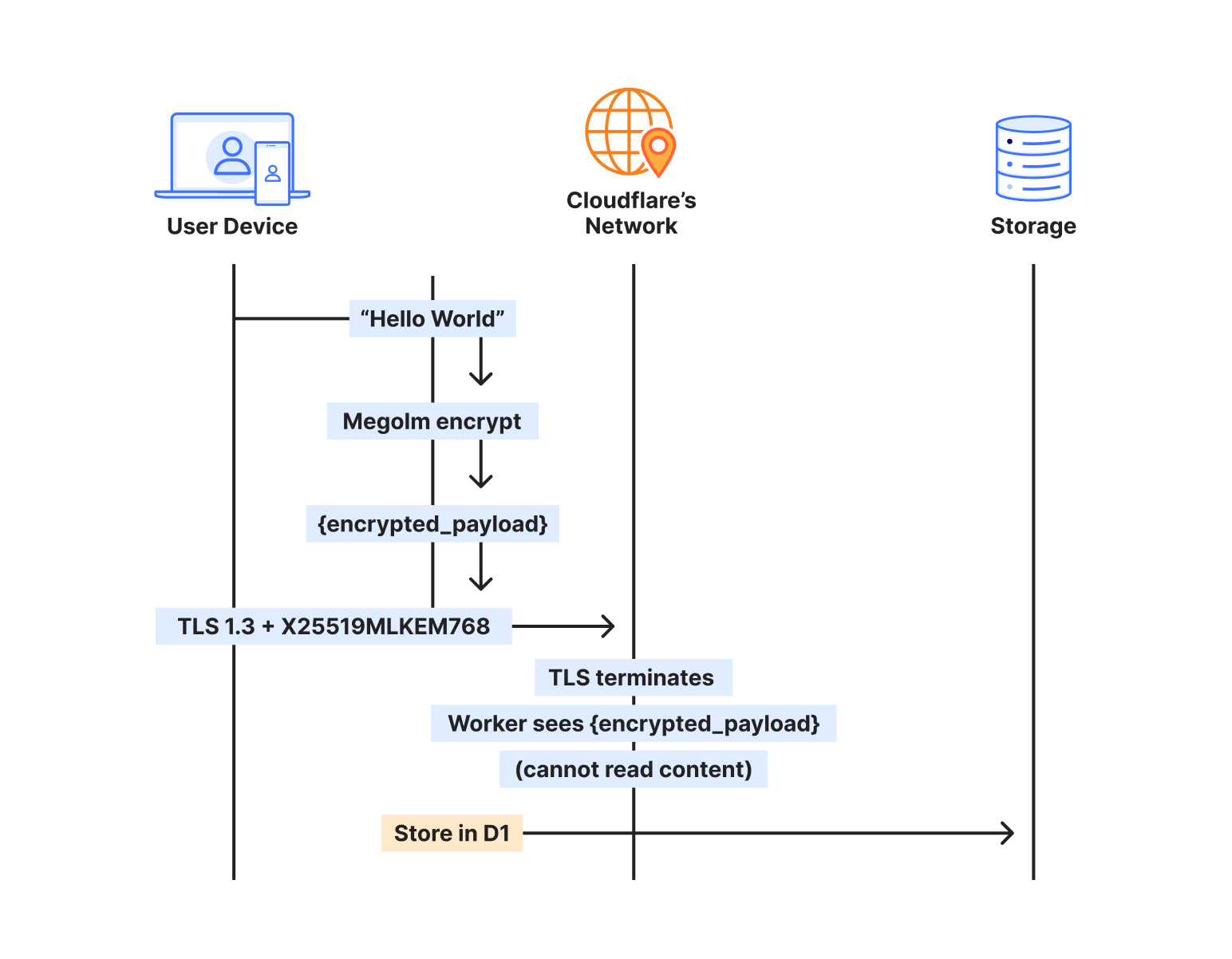
The Worker terminates TLS, but what it receives is still encrypted — the Megolm ciphertext. We store that ciphertext in D1, index it by room and timestamp, and deliver it to recipients. But we never see the plaintext. The message “Hello, world” exists only on the sender’s device and the recipient’s device.
When the recipient syncs, the process reverses. They receive the encrypted payload over another quantum-resistant TLS connection, then decrypt locally with their Megolm session keys.
This creates defense in depth through two encryption layers that operate independently:
The transport layer (TLS) protects data in transit. It’s encrypted at the client and decrypted at the Cloudflare edge. With X25519MLKEM768, this layer is now post-quantum.
The application layer (Megolm E2EE) protects message content. It’s encrypted on the sender’s device and decrypted only on recipient devices. This uses classical Curve25519 cryptography.
Here’s why this architecture matters: Even if Matrix E2EE is eventually broken by quantum computers, the message content was never transmitted in a quantum-vulnerable form. The TLS layer that carried the E2EE ciphertext was itself post-quantum secured.
The post-quantum TLS acts as a quantum-resistant envelope around everything, including the classical E2EE layer. This buys time for the Matrix protocol to migrate to post-quantum E2EE algorithms without leaving current communications vulnerable to harvest-now-decrypt-later attacks.
Any Matrix homeserver operator — whether running Synapse on a VPS or this implementation on Workers — can see metadata: which rooms exist, who’s in them, when messages were sent. This is inherent to operating the server. You’re the operator; you control the infrastructure.
What no one in the infrastructure chain can see: message content. The E2EE payload is encrypted on sender devices before it ever hits the network. Cloudflare terminates TLS and passes requests to your Worker, but both see only Megolm ciphertext. Media in encrypted rooms is encrypted client-side before upload. Private keys never leave user devices.
The server processes ciphertext, not conversations. That’s true whether you’re self-hosting on bare metal or running on Workers.
Achieving post-quantum TLS on a traditional Matrix deployment would require upgrading OpenSSL or BoringSSL to a version supporting ML-KEM, configuring cipher suite preferences correctly, testing client compatibility across all Matrix apps, monitoring for TLS negotiation failures, staying current as PQC standards evolve, and handling clients that don’t support PQC gracefully.
With Workers, it’s automatic. Chrome, Firefox, and Edge all support X25519MLKEM768. Mobile apps using platform TLS stacks inherit this support. The security posture improves as Cloudflare’s PQC deployment expands — no action required on our part.
The key insight from porting Tuwunel was that different data needs different consistency guarantees. We use each Cloudflare primitive for what it does best.
D1 stores everything that needs to survive restarts and support queries: users, rooms, events, device keys. Over 25 tables covering the full Matrix data model.
CREATE TABLE events (
	event_id TEXT PRIMARY KEY,
	room_id TEXT NOT NULL,
	sender TEXT NOT NULL,
	event_type TEXT NOT NULL,
	state_key TEXT,
	content TEXT NOT NULL,
	origin_server_ts INTEGER NOT NULL,
	depth INTEGER NOT NULL
);
D1’s SQLite foundation meant we could port Tuwunel’s queries with minimal changes. Joins, indexes, and aggregations work as expected.
We learned one hard lesson: D1’s eventual consistency breaks foreign key constraints. A write to rooms might not be visible when a subsequent write to events checks the foreign key — different replicas, different views of the world. We removed all foreign keys and enforce referential integrity in application code.
OAuth authorization codes live for 10 minutes. Refresh tokens last for a session. None of this needs SQL — it needs fast key-value access with automatic expiration.
// Store OAuth code with 10-minute TTL
kv.put(&format!("oauth_code:{}", code), &token_data)?
	.expiration_ttl(600)
	.execute()
	.await?;
KV’s global distribution means OAuth flows work fast regardless of where users are located.
Matrix media maps directly to R2. Upload an image, get back a content-addressed URL. Egress is free, which matters for a protocol where clients frequently download the same avatars and images.
Some operations can’t tolerate eventual consistency. When a client claims a one-time encryption key, that key must be atomically removed. If two clients claim the same key, encrypted session establishment fails.
Durable Objects provide single-threaded, strongly consistent storage:
#[durable_object]
pub struct UserKeysObject {
	state: State,
	env: Env,
}

impl UserKeysObject {
	async fn claim_otk(&self, algorithm: &str) -> Result<Option<Key>> {
    	// Atomic within single DO - no race conditions possible
    	let mut keys: Vec<Key> = self.state.storage()
        	.get("one_time_keys")
        	.await
        	.ok()
        	.flatten()
        	.unwrap_or_default();

    	if let Some(idx) = keys.iter().position(|k| k.algorithm == algorithm) {
        	let key = keys.remove(idx);
        	self.state.storage().put("one_time_keys", &keys).await?;
        	return Ok(Some(key));
    	}
    	Ok(None)
	}
}
We use UserKeysObject for E2EE key management, RoomObject for real-time room events like typing indicators and read receipts, and UserSyncObject for to-device message queues. The rest flows through D1.
End-to-end encryption is non-negotiable for secure communications. Our implementation supports the full Matrix E2EE stack: device keys, cross-signing keys, one-time keys, fallback keys, key backup, and dehydrated devices.
Modern Matrix clients use OAuth 2.0/OIDC instead of legacy password flows. We implemented a complete OAuth provider: dynamic client registration, PKCE authorization, RS256-signed JWT tokens, token refresh with rotation, and standard OIDC discovery endpoints.
curl https://matrix.example.com/.well-known/openid-configuration
{
  "issuer": "https://matrix.example.com",
  "authorization_endpoint": "https://matrix.example.com/oauth/authorize",
  "token_endpoint": "https://matrix.example.com/oauth/token",
  "jwks_uri": "https://matrix.example.com/.well-known/jwks.json"
}
Point Element or any Matrix client at the domain, and it discovers everything automatically.
Traditional Matrix sync transfers megabytes of data on initial connection — every room, every state event, recent timeline for each. This destroys mobile battery and data plans.
Sliding Sync lets clients request exactly what they need. Instead of downloading everything, clients get the 20 most recent rooms with minimal state. As users scroll, they request more ranges. The server tracks position and sends only deltas.
Combined with edge execution, mobile clients can connect and render their room list in under 500ms — even on slow networks.
For a homeserver serving a small team:
| Traditional (VPS) | Workers |
|---|---|---|
Monthly cost (idle) | $20-50 | <$1 |
Monthly cost (active) | $20-50 | $3-10 |
Global latency | 100-300ms | 20-50ms |
Time to deploy | Hours | Seconds |
Maintenance | Weekly | None |
DDoS protection | Additional cost | Included |
Post-quantum TLS | Complex setup | Automatic |
*Based on public rates and metrics published by DigitalOcean, AWS Lightsail, and Linode as of January 15, 2026.
The economics improve further at scale. Traditional deployments require capacity planning and over-provisioning. Workers scale automatically.
When we started this project, the goal was simply to see if the pieces would fit. Could a protocol as complex and stateful as Matrix — designed for heavy iron and persistent file systems — actually run on an ephemeral, serverless edge?
The answer is yes, but the implication is bigger than just Matrix.
By mapping traditional stateful components to Cloudflare’s primitives — Postgres to D1, Redis to KV, mutexes to Durable Objects — we proved that complex applications don’t need complex infrastructure. We stripped away the operating system, the database management, and the network configuration, leaving only the application logic and the data itself.
This architecture shifts the paradigm for self-hosting. It turns “running a server” from a chore into a utility. You get the sovereignty of owning your data without the burden of owning the infrastructure.
Matrix on Workers runs in production today, handling real encrypted communications for our team. It is fast, it is cheap, and it is arguably one of the most secure ways to deploy a homeserver today.
Ready to build secure, real-time applications on Workers? Get started with Cloudflare Workers and explore Durable Objects for your own stateful edge applications. Join our Discord community to connect with other developers building at the edge.
Read more here: https://blog.cloudflare.com/serverless-matrix-homeserver-workers/