During Security Week 2025, we launched the industry’s first cloud-native post-quantum Secure Web Gateway (SWG) and Zero Trust solution, a major step towards securing enterprise network traffic sent from end user devices to public and private networks.
But this is only part of the equation. To truly secure the future of enterprise networking, you need a complete Secure Access Service Edge (SASE).
Today, we complete the equation: Cloudflare One is the first SASE platform to support modern standards-compliant post-quantum (PQ) encryption in our Secure Web Gateway, and across Zero Trust and Wide Area Network (WAN) use cases. More specifically, Cloudflare One now offers post-quantum hybrid ML-KEM (Module-Lattice-based Key-Encapsulation Mechanism) across all major on-ramps and off-ramps.
To complete the equation, we added support for post-quantum encryption to our Cloudflare IPsec (our cloud-native WAN-as-a-Service) and Cloudflare One Appliance (our physical or virtual WAN appliance that establish Cloudflare IPsec connections). Cloudflare IPsec uses the IPsec protocol to establish encrypted tunnels from a customer’s network to Cloudflare’s global network, while IP Anycast is used to automatically route that tunnel to the nearest Cloudflare data center. Cloudflare IPsec simplifies configuration and provides high availability; if a specific data center becomes unavailable, traffic is automatically rerouted to the closest healthy data center. Cloudflare IPsec runs at the scale of our global network, and supports site-to-site across a WAN as well as outbound connections to the Internet.
The Cloudflare One Appliance upgrade is generally available as of appliance version 2026.2.0. The Cloudflare IPsec upgrade is in closed beta, and you can get on the list by reaching out to your account team pq-wan@cloudflare.com.
Quantum threats are not a “next decade” problem. Here is why our customers are prioritizing post-quantum cryptography (PQC) today:
The deadline is approaching. At the end of 2024, the National Institute of Standards and Technology (NIST) sent a clear signal (that has been echoed by other agencies): the era of classical public-key cryptography is coming to an end. NIST set a 2030 deadline for depreciating RSA and Elliptic Curve Cryptography (ECC) and transitioning to PQC that cannot be broken by powerful quantum computers. Organizations that haven’t begun their migration risk being out of compliance and vulnerable as the deadline nears.
Upgrades have historically been tricky. While 2030 might seem far away, upgrading cryptographic algorithms is notoriously difficult. History has shown us that depreciating cryptography can take decades: we found examples of MD5 causing problems 20 years after it was deprecated. This lack of crypto agility — the ability to easily swap out cryptographic algorithms — is a major bottleneck. By integrating PQ encryption directly into Cloudflare One, our SASE platform, we provide built-in crypto agility, simplifying how organizations offer remote access and site-to-site connectivity.
Data may already be at risk. Finally, “Harvest Now, Decrypt Later” is a present and persistent threat, where attackers harvest sensitive network traffic today and then store it until quantum computers become powerful enough to decrypt it. If your data has a shelf life of more than a few years (e.g. financial information, health data, state secrets) it is already at risk unless it is protected by PQ encryption.
Transitioning network traffic to post-quantum cryptography (PQC) requires an overhaul of two cryptographic primitives: key agreement and digital signatures.
Migration 1: Key establishment. Key agreement allows two parties to establish a shared secret over an insecure channel; the shared secret is then used to encrypt network traffic, resulting in post-quantum encryption. The industry has largely converged on ML-KEM (Module-Lattice-based Key-Encapsulation Mechanism) as the standard PQ key agreement protocol.
ML-KEM has been widely adopted for use in TLS, usually deployed alongside classical Elliptic Curve Diffie Hellman (ECDHE), where the key used to encrypt network traffic is derived by mixing the outputs of the ML-KEM and ECDHE key agreements. (This is also known as “hybrid ML-KEM”). Well over 60% of human-generated TLS traffic to Cloudflare’s network is currently protected with hybrid ML-KEM. The transition to hybrid ML-KEM has been successful because it:
stops “harvest-now, decrypt-later” attacks
does not require specialized hardware or specialized physical connectivity between client and server, unlike approaches like Quantum Key Distribution (QKD)
has little impact on performance, even for short-lived TLS connections
Because ML-KEM runs in parallel with classical ECDHE, there is no reduction in security and compliance as compared to the classical ECDHE approach.
Migration 2: Digital signatures. Meanwhile, digital signatures and certificates protect authenticity, stopping active adversaries from impersonating the server to the client. Unfortunately, PQ signatures are currently larger in size than classical ECC algorithms, which has slowed their adoption. Fortunately, the migration to PQ signatures is less urgent, because PQ signatures are designed to stop active adversaries armed with powerful quantum computers, which are not known to exist yet. Thus, while Cloudflare is actively contributing to the standardization and rollout of PQ digital signatures, the current Cloudflare IPsec upgrade focuses on upgrading key establishment to hybrid ML-KEM.
The U.S. Cybersecurity & Infrastructure Security Agency (CISA) recognized the nature of these two migrations in its January 2026 publication, “Product Categories for Technologies That Use Post-Quantum Cryptography Standards.”
To achieve a SASE fully protected with post-quantum encryption, we’ve upgraded our Cloudflare IPsec products to support hybrid ML-KEM in the IPsec protocol.
The IPsec community’s journey toward post-quantum cryptography has been very different from that of TLS. TLS is the de facto standard for encrypting public Internet traffic at Layer 4 — e.g. from a browser to a content delivery network (CDN) — so security and vendor interoperability are at the forefront of its design. Meanwhile, IPsec is a Layer 3 protocol that commonly connects devices built by the same vendor (e.g. two routers), so interoperability has historically been less of a concern. With this in mind, let’s take a look at IPsec’s journey into the quantum future.
RFC 8784, published in May 2020, was intended to be the post-quantum update to IPsec Internet Key Exchange v2 (IKEv2), which is used to establish the symmetric keys used to encrypt IPsec network traffic. RFC 8784 implies the use of either long-lived pre-shared keys (PSK) or quantum key distribution (QKD). Neither of these approaches are very palatable.
RFC 8784 proposes mixing a PSK with a key derived from Diffie Hellman Exchange (DHE), essentially running PSK in hybrid with DHE. This approach protects against harvest-now-decrypt-later attackers, but does not offer forward secrecy against quantum adversaries.
Forward secrecy is a standard desideratum of key agreement protocols. It ensures that a system is secure even if the long-lived key is leaked. The PSK approach in RFC 8784 is vulnerable to an harvest-now-decrypt-later adversary that also obtains a copy of a long-lived PSK, and can then decrypt traffic in the future (by breaking the DHE key agreement) once powerful quantum computers become available.
To solve this forward secrecy issue, RFC 8784 can instead be used to mix the key from the classical DHE with a freshly generated key derived from a QKD protocol.
QKD uses quantum mechanics to establish a shared, secret cryptographic key between two parties. Importantly, for QKD to work, the parties must have specialized hardware or be connected by a dedicated physical connection. This is a significant limitation, rendering QKD useless for common Internet use cases like connecting a laptop to a distant server over Wi-Fi. These limitations are also why we never invested in deploying QKD for Cloudflare IPsec. The U.S. National Security Agency (NSA), Germany’s BSI and the UK National Cyber Security Centre have also warned against relying solely on QKD.
RFC 9370 landed in May 2023, specifying the use of hybrid key agreement rather than PSK or QKD. But unlike TLS, which only supports using post-quantum ML-KEM in parallel with classical DHE, this IPsec standard allows using up to seven different key agreements to run at the same time in parallel with classical Diffie Helman. Moreover, it doesn’t specify details about what these key agreements should be, leaving it up to the vendors to choose their algorithms and implementations. Palo Alto Networks, for example, took this seriously and built support for over seven different PQC ciphersuites into its next generation firewall (NGFW), most of which do not interoperate with other vendors and some of which have not yet been standardized by NIST.
Over the years, TLS has gone in the opposite direction, reducing the number of registered ciphersuites from hundreds in TLS 1.2, down to around five in TLS 1.3. This philosophy of reducing “ciphersuite bloat” is also in line with NIST’s SP 800 52 from 2019. The rationale for reducing “ciphersuite bloat” includes:
Improved interoperability across vendors and regions
Lower risk of attacks that exploit downgrades to weak ciphersuites
Lower risk of security problems due to misconfiguration
Lower risk of implementation flaws by reducing the size of the codebase
This is why we didn’t initially build support for RFC 9370.
It’s also why we were excited when the IPsec community put forth draft-ietf-ipsecme-ikev2-mlkem. This Internet-Draft standardizes PQ exchange for IPsec in the same way PQ key exchange has been widely deployed for TLS: hybrid ML-KEM. The new draft fills in the gaps in RFC 9370, by specifying how to run the ML-KEM as the additional key exchange in parallel with classical Diffie Hellman in IKEv2.
Now that this specification is available, we’ve moved forward with supporting post-quantum IPsec in our Cloudflare IPsec products.
Cloudflare IPsec is a WAN Network-as-a-Service solution that replaces legacy private network architectures by connecting data centers, branch offices, and cloud VPCs to Cloudflare’s global IP Anycast network.
With Cloudflare IPsec, Cloudflare’s network acts as the IKEv2 Responder, awaiting connection requests from an IPsec initiator, which is a branch connector device in the customer’s network. Cloudflare IPsec supports IPsec sessions initiated by branch connectors that include our own Cloudflare One Appliance, along with branch connectors from a diverse set of vendors, including Cisco, Juniper, Palo Alto Networks, Fortinet, Aruba and others.
We’ve implemented production hybrid ML-KEM support in the Cloudflare IPsec IKEv2 Responder, as specified in draft-ietf-ipsecme-ikev2-mlkem. The draft requires a first key exchange to run using a classical Diffie Helman key exchange. The derived key is used to encrypt a second key exchange that is run using ML-KEM. Finally, the keys derived by the two exchanges are mixed and the result is used to secure the data plane traffic in IPsec ESP (Encapsulating Security Payload) mode. ESP mode uses symmetric cryptography and is thus already quantum safe without any additional upgrades. We’ve tested our implementation against the IPsec Initiator in the strongswan reference implementation.
You can see the ciphersuite used in the IKEv2 negotiation by viewing the Cloudflare IPsec logs.
We chose to implement hybrid ML-KEM rather than “pure” ML-KEM, i.e. only ML-KEM without DHE running in parallel, for two reasons. First, we’ve used hybrid ML-KEM across all of our other Cloudflare products, since this is the approach adopted across the TLS community. And second, it provides a “belt-and-suspenders” security: ML-KEM provides protection against quantum harvest-now-decrypt-later attacks, while DHE provides a tried-and-true algorithm against non-quantum adversaries.
The full value of this implementation can be realized only via interoperability. For this reason, we are inviting other vendors that are building out support for IPsec Initiators in their branch connectors per draft-ietf-ipsecme-ikev2-mlkem to test against our Cloudflare IPsec implementation. Cloudflare customers looking to test out interoperability with third-party branch connectors while we are in closed beta can get in touch with us by reaching out to your account team at pq-wan@cloudflare.com. We plan to GA and build out interoperability with other vendors as more begin to come online with support for draft-ietf-ipsecme-ikev2-mlkem.
Many of our customers purchase their branch connector (hardware or virtualized) from Cloudflare, rather than a third-party vendor. That’s why the Cloudflare One Appliance — our plug-and-play appliance that connects your local network to Cloudflare One — has also been upgraded with post-quantum encryption.
Cloudflare One Appliance does not use IKEv2 for key agreement or session establishment, opting instead to rely on TLS. The appliance periodically initiates a TLS handshake with the Cloudflare edge, shares a symmetric secret over the resulting TLS connection, then injects that symmetric secret into the ESP layer of IPsec, which then encrypts and authenticates the IPsec data plane traffic. This design allowed us to avoid building out IKEv2 Initiator logic, and makes the Connector easier to maintain using our existing TLS libraries.
Thus, upgrading Cloudflare One Appliance to PQ encryption was just a matter of upgrading TLS 1.2 to TLS 1.3 with hybrid ML-KEM — something we’ve done many times on different products at Cloudflare.
As always, this upgrade to Cloudflare IPsec comes at no extra cost to our customers. Because we believe that a secure and private Internet should be accessible to all, we’re on a mission to include PQC in all our products, without specialized hardware, at no extra cost to our customers and end users.
Customers using the Cloudflare One Appliance obtained this upgrade to PQC in version 2026.2.0 (released 2026-02-11). The upgrade is pushed automatically (with no customer action required) according to each appliance’s configured interrupt window.
For customers using Cloudflare IPsec with another vendor’s branch connector appliance, we will be interoperating with these once more support for draft-ietf-ipsecme-ikev2-mlkem comes online. You can also contact us directly to get access to closed beta and request that we interoperate with a specific vendor’s branch connector by reaching out to your account team at pq-wan@cloudflare.com.
The value proposition for a post-quantum SASE is clear: organizations can obtain immediate end-to-end protection for their private network traffic by sending it over tunnels protected by hybrid ML-KEM. This protects traffic from harvest-now-decrypt-later attacks, even if the individual applications in the corporate network are not yet upgraded to PQC.

The diagram above shows how post-quantum hybrid ML-KEM is offered in various Cloudflare One network configurations. It includes the following on-ramps:
clientless (TLS 1.3 with hybrid ML-KEM (assuming the browser supports hybrid ML-KEM))
Cloudflare One Client ( MASQUE over TLS 1.3 with hybrid ML-KEM initiated by the device client)
Cloudflare IPsec on-ramp (as described in this blog)
and the following off-ramps:
Cloudflare Tunnel off-ramp (TLS 1.3 with hybrid ML-KEM tunnel initiated by the cloudflared device client)
Cloudflare IPsec on-ramp (as described in this blog)
The diagram below highlights a sample network configuration that uses the Cloudflare One Client on-ramp to connect a device to a server behind a Cloudflare One Appliance offramp. The end user’s device connects to the Cloudflare network (link 1) using MASQUE with hybrid ML-KEM. The traffic then travels across Cloudflare’s global network over TLS 1.3 with hybrid ML-KEM (link 2). Traffic then leaves the Cloudflare network over a post-quantum Cloudflare IPsec link (link 3) that is terminated at a Cloudflare One Appliance appliance. Finally it connects to a server inside the customer’s environment. Traffic is protected by post-quantum cryptography as it travels over the public Internet, even if the server itself does not support post-quantum cryptography.

Finally, we note that traffic that on-ramps to Cloudflare One and then egresses to the public Internet can also be protected by our post-quantum Cloudflare Gateway, our Secure Web Gateway (SWG). Here’s a diagram showing how the SWG works:
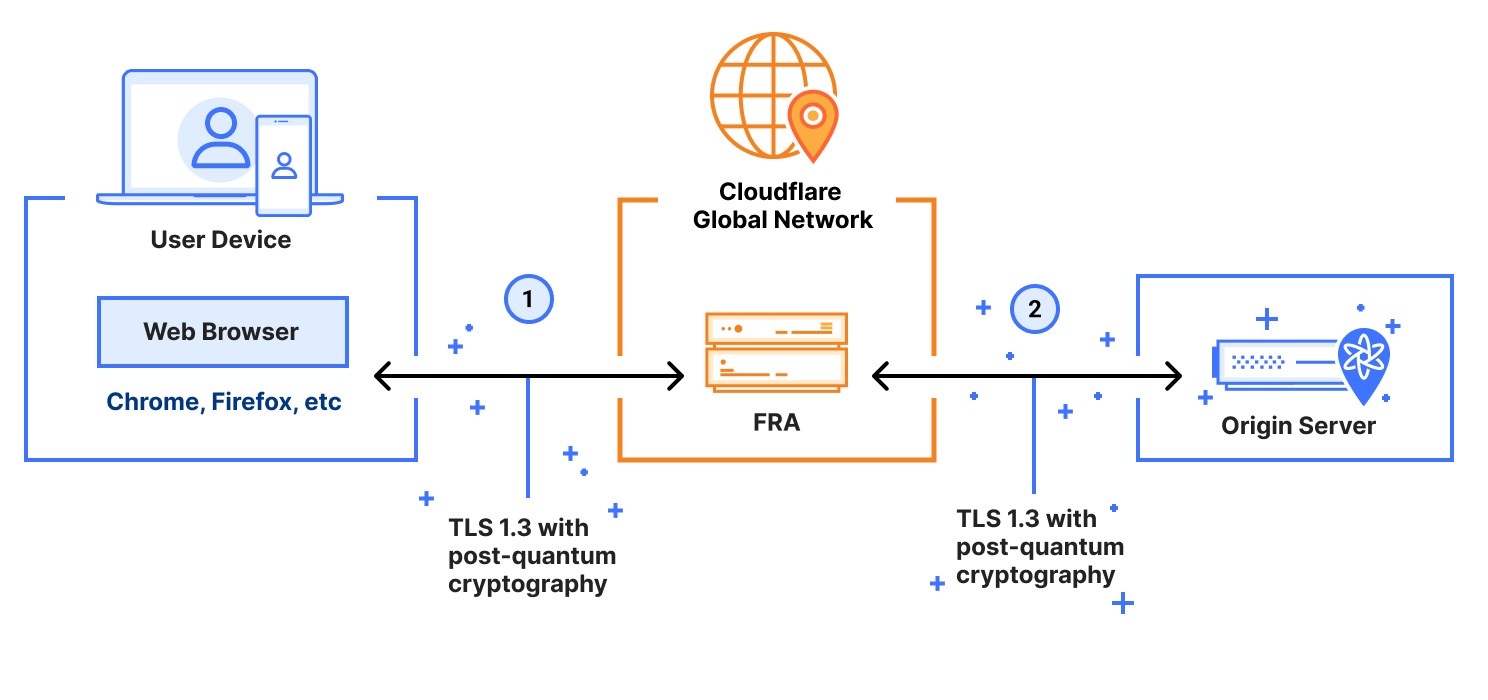
As discussed in an earlier blog post, our SWG can already support hybrid ML-KEM on traffic from SWG to the origin server (as long as the origin supports hybrid ML-KEM), and on traffic from the client to the SWG (if the client supports hybrid ML-KEM, which is the case for most modern browsers). Importantly, any traffic that onramps to the SWG via a device that has Cloudflare One Client installed is still protected with hybrid ML-KEM — even if the web browser itself does not yet support post-quantum cryptography. This is due to the post-quantum MASQUE tunnel that the Cloudflare One Client establishes to Cloudflare’s global network. The same is true of traffic that onramps to the SWG via a post-quantum Cloudflare IPsec tunnel.
Putting it all together, Cloudflare One now offers post-quantum encryption on our TLS, MASQUE and IPsec on-ramp and off-ramps, and for private network traffic, and to traffic that egresses to the public Internet via our SWG.
By completing the post-quantum SASE equation with Cloudflare IPsec and the Cloudflare One Appliance, we have extended post-quantum encryption across all our major on-ramps and off-ramps. We have intentionally chosen the path of interoperability and simplicity — the hybrid ML-KEM approach that the IETF and NIST have championed, rather than locking our customers into proprietary implementations, “ciphersuite bloat,” or unnecessary hardware upgrades.
This is the promise of Cloudflare One: a SASE platform that is not only faster and more reliable than the legacy architectures it replaces, but one that provides post-quantum encryption. Whether you are securing a remote worker’s browser or a multi-gigabit data center link, you can now do so with the confidence that your data is protected from harvest-now-decrypt-later attacks and other future-looking threats.
You can sign up here to get a full demo of our post-quantum capabilities across the Cloudflare One SASE platform. We are proud to lead the industry into this new era of cryptography, and we invite you to join us in building a scalable, standards-compliant, and post-quantum Internet.
Read more here: https://blog.cloudflare.com/post-quantum-sase/