We’re seeing two big tech ideas, blockchain and artificial intelligence, start to work together. It’s not just about one helping the other; it’s more like they’re creating something new. Think about how much data we generate now, especially from all our connected devices. Keeping that data safe and making sense of it is tough. That’s where this partnership comes in. By combining blockchain’s secure record-keeping with AI’s smart analysis, we’re opening doors to new ways of doing things. This article looks at how these two technologies, blockchain and artificial intelligence, are changing industries and what that means for the future.
Key Takeaways
- Combining blockchain and artificial intelligence improves how we manage and secure data, especially from connected devices.
- Blockchain can create secure digital identities for devices and people, making transactions more trustworthy.
- Smart contracts, powered by blockchain, can automate processes when combined with AI, even for devices acting on their own.
- This partnership helps address privacy concerns and detect suspicious activities in our increasingly connected digital world.
- New business ideas are emerging, like turning devices into profit centers and creating smarter, self-running systems.
Understanding The Synergy Between Blockchain and Artificial Intelligence
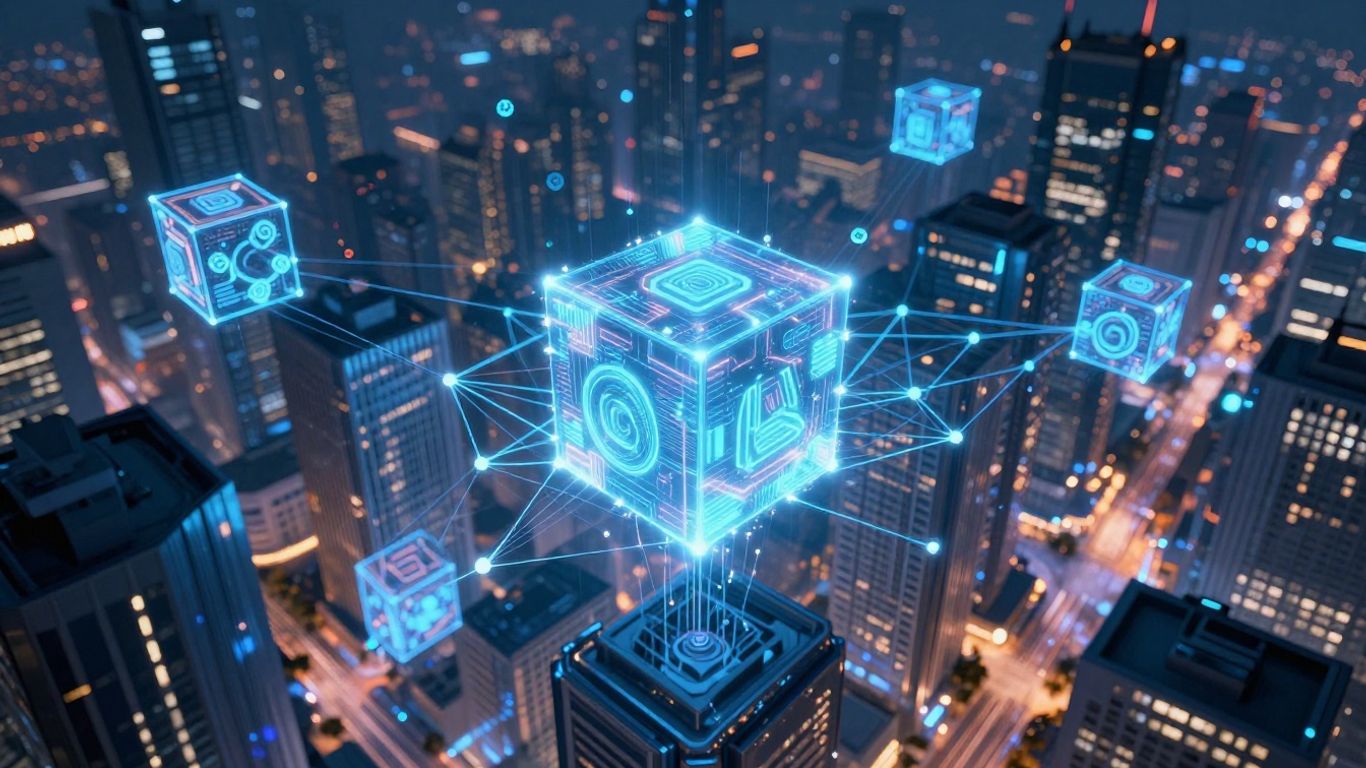
It’s pretty interesting how two big tech ideas, blockchain and artificial intelligence (AI), are starting to work together. For a while, blockchain was mostly known for things like Bitcoin, but now we’re seeing it used for all sorts of other stuff, like keeping track of products in a supply chain or managing who is who online. When you add AI into the mix, things get even more exciting.
Enhancing Data Management Through Combined Strengths
Think about all the data generated by devices, especially with the Internet of Things (IoT) growing so fast. Managing all that information can be a real headache. Blockchain brings a few key things to the table: it’s transparent, it’s hard to tamper with, and it builds trust. This means data recorded on a blockchain is reliable. AI, on the other hand, is brilliant at finding patterns and making sense of large amounts of data. When you put them together, blockchain can provide a secure and trustworthy place to store the data that AI then analyzes. This combination can make managing IoT data much more organized and dependable.
The Role of Blockchain in Securing AI-Driven Insights
AI can come up with some pretty smart conclusions, but how do we know those insights are based on good data? This is where blockchain steps in. By recording the data used to train AI models on a blockchain, we create an unchangeable history. This makes it clear exactly what information the AI used to reach its conclusions. It also helps in verifying the authenticity of the AI’s output. If an AI suggests a certain action, we can trace back the data it used on the blockchain to confirm its reasoning. This is especially important in fields where accuracy and accountability are paramount.
AI’s Contribution to Blockchain Scalability and Efficiency
One of the common criticisms of blockchain is that it can be slow and use a lot of energy, especially older systems. However, newer methods are making blockchains faster and more energy-friendly. AI can actually help here too. Imagine AI systems that can intelligently adjust how a blockchain operates – maybe by choosing the best way to confirm transactions or deciding how often new blocks of data are added. This kind of smart adjustment, powered by AI, can significantly speed up blockchain operations and make them more efficient, allowing them to handle more activity without getting bogged down.
Fortifying Digital Identities and Transactions
In our increasingly connected world, the ability to securely identify individuals, devices, and machines is paramount. This is where blockchain technology steps in, offering a robust framework for managing digital identities and ensuring the integrity of transactions.
Blockchain-Powered Authentication for IoT Devices
Think about the sheer number of devices coming online every day – smart home gadgets, industrial sensors, even autonomous vehicles. Each of these needs a way to be identified reliably. Blockchain provides a decentralized ledger where these identities can be registered and verified. This means a device can have a unique, tamper-proof digital ID, making it much harder for unauthorized entities to impersonate it. This immutable record is key to building trust in machine-to-machine interactions.
Streamlining Transactions with Secure Digital Identities
When devices or people interact and exchange value, secure identification is crucial. Blockchain-based digital identities can simplify this process. Instead of relying on multiple, often vulnerable, centralized databases, a single, secure blockchain identity can be used. This not only speeds up verification but also reduces the risk of identity theft or fraudulent transactions. Imagine an autonomous car paying for parking – it can do so securely using its blockchain-verified identity, without human intervention.
Building Trust in Machine-to-Machine Interactions
As more devices become capable of independent action, establishing trust between them is a significant challenge. Blockchain’s inherent transparency and immutability create a foundation of trust. When machines can reliably verify each other’s identities and the history of their interactions, complex automated processes become feasible. This opens doors for new service models, like pay-per-use features for devices, all managed through secure, automated transactions.
The convergence of blockchain and AI is particularly exciting for identity management. AI can analyze patterns within blockchain transactions to detect anomalies, further bolstering security. Meanwhile, blockchain ensures that the data AI uses for these analyses is trustworthy and has a verifiable origin.
Automating Processes with Smart Contracts and AI
The Power of Smart Contracts in Connecting Technologies
Smart contracts are like digital agreements that automatically carry out the terms when certain conditions are met. Think of them as “if-then” statements written in code. For instance, if a delivery is confirmed, a payment can be sent automatically. This capability makes them a key piece in linking technologies like blockchain, the Internet of Things (IoT), and artificial intelligence (AI). They act as the glue, allowing these different systems to interact and execute tasks without human intervention.
Overcoming Limitations of Traditional Smart Contracts
While smart contracts hold immense promise, traditional ones face hurdles, especially for businesses. A major issue is their reliance on specific cryptocurrencies, like Ether. Companies often hesitate to use these due to price swings and regulatory uncertainties. Imagine a contract that depends on Ether’s value – a sudden drop could mean a significant loss for one party. Even stablecoins, designed to avoid volatility, present challenges. They might be unregulated, and integrating them with existing company accounting systems, which use traditional currencies like the Euro, adds complexity and cost.
The real potential of smart contracts can only be realized when they can operate using familiar, stable currencies. This means moving towards blockchain-based versions of traditional money, like a digital Euro, to simplify transactions and reduce risk for businesses.
Enabling Autonomous Device Operations
When smart contracts are combined with AI and blockchain, they can enable devices to operate more autonomously. For example, IoT devices can record data about their usage and performance on a blockchain. AI can then analyze this data to optimize operations. Consider smart streetlights: AI could predict when maintenance is needed based on usage patterns recorded on the blockchain and even automatically schedule repairs. This leads to less downtime and more efficient management. This integration allows for a future where machines can not only interact but also manage themselves and their resources with minimal human oversight.
Here’s how this automation can work:
- Data Recording: IoT devices log operational data (e.g., usage, errors) onto an immutable blockchain ledger.
- AI Analysis: AI algorithms process this blockchain data to identify trends, predict failures, or suggest optimizations.
- Automated Execution: Smart contracts trigger actions based on AI insights, such as ordering replacement parts or dispatching maintenance crews.
- Financial Transactions: Payments for services or parts can be automatically handled via smart contracts, potentially using blockchain-based fiat currencies.
Addressing Security and Privacy in a Connected World

In today’s increasingly interconnected digital landscape, where devices constantly exchange information, maintaining robust security and safeguarding privacy are paramount. The convergence of blockchain and artificial intelligence (AI) offers novel approaches to tackle these challenges head-on.
Leveraging Blockchain for Data Privacy by Design
Blockchain technology inherently promotes a ‘privacy by design’ philosophy. Unlike traditional systems where data might be sent unencrypted, blockchain architecture allows for data to be encrypted from the outset. Access to this data is managed through cryptographic keys, meaning only the intended device or user can read or write specific information. This is particularly important for the vast amounts of sensitive data generated by Internet of Things (IoT) devices.
- Data Encryption: Information is secured using advanced cryptographic methods.
- Access Control: Private and public key infrastructure dictates who can access what data.
- Immutability: Once data is recorded on the blockchain, it cannot be altered, providing a trustworthy audit trail.
The decentralized nature of blockchain means there’s no single point of failure that hackers can target, making it significantly more resilient than many centralized databases.
AI’s Role in Detecting Illicit Activities on Blockchains
While blockchain offers strong security, the anonymity it can provide, especially in public blockchains, can sometimes be exploited for illicit purposes. This is where AI steps in. By analyzing transaction patterns and network behavior, AI algorithms can identify anomalies that might indicate fraudulent or illegal activities. The more data AI has to learn from, the better it becomes at spotting these suspicious events.
- Pattern Recognition: AI can identify unusual transaction volumes or sequences.
- Behavioral Analysis: Machine learning models can flag deviations from normal network activity.
- Predictive Security: AI can help anticipate potential threats before they materialize.
Ensuring Resilience Against Cyber Threats
Combining blockchain’s inherent security features with AI’s analytical capabilities creates a powerful defense against cyber threats. Blockchain’s distributed ledger makes it incredibly difficult to tamper with data, while AI can actively monitor for and respond to potential intrusions. This dual approach helps build a more secure and trustworthy digital environment for all connected devices and users.
- Decentralized Defense: No single point of attack.
- Real-time Monitoring: AI provides continuous oversight.
- Adaptive Security: Systems can learn and adapt to new threats.
Pioneering New Business Models with Blockchain and AI
The combination of blockchain and artificial intelligence isn’t just about making existing systems better; it’s about creating entirely new ways for businesses to operate and generate value. Think about how devices are becoming more connected. With the Internet of Things (IoT) growing rapidly, we have billions of devices generating data. Blockchain can provide a secure and transparent way to manage this data and the transactions that come with it. AI, on the other hand, can analyze this data to find patterns and make smart decisions.
Monetizing IoT Devices Through Tokenization
One of the most exciting possibilities is turning everyday devices into revenue streams. Imagine your smart refrigerator, instead of just keeping your food cold, could automatically order groceries when supplies run low. This order could be placed via a smart contract on a blockchain, and the payment processed securely. But it goes further. These devices themselves can be represented as digital tokens on a blockchain. This means investors could buy tokens representing a share in a device’s future earnings. For example, a fleet of delivery trucks could be tokenized, allowing investors to earn a portion of the profits generated by their deliveries. This opens up investment opportunities to a wider audience and provides capital for deploying more devices.
- Asset Representation: Any connected device, from sensors to vehicles, can be tokenized.
- Investment Opportunities: Investors can gain fractional ownership and earn returns.
- Automated Revenue Sharing: Smart contracts can distribute profits automatically based on device usage.
The Potential of Blockchain-Based Digital Currencies
Beyond tokenizing physical assets, blockchain technology is the foundation for digital currencies. While cryptocurrencies like Bitcoin are well-known, the future holds more specialized digital currencies. These could be used for specific industries or even for machine-to-machine payments. Imagine autonomous cars paying for charging or parking automatically using a dedicated digital currency. This streamlines transactions and reduces reliance on traditional financial intermediaries. The integration with AI means these transactions can be optimized for speed and cost, making micro-transactions economically viable. This is a significant step towards a future where devices can participate directly in the economy, a concept explored in AI tech consulting that aims to integrate such advanced solutions into business strategies.
Creating Self-Sustaining, Intelligent Systems
When you combine tokenization, smart contracts, and AI, you can build systems that manage themselves. Consider a smart city infrastructure. Streetlights could use sensors to detect traffic and adjust their brightness, saving energy. This data, recorded on a blockchain, could trigger payments to the energy provider via smart contracts. AI could analyze usage patterns to predict maintenance needs, automatically ordering parts and scheduling repairs. The entire system becomes more efficient, resilient, and even profitable, with potential revenue streams from data or services managed through tokenization. This creates a cycle of intelligence and automation that can be applied to numerous industries, from manufacturing to agriculture.
The convergence of blockchain and AI allows for the creation of decentralized autonomous organizations (DAOs) where systems can operate and make decisions without direct human intervention, driven by code and data.
The Future Landscape of Blockchain and Artificial Intelligence
Driving Innovation Across Industries
The combination of blockchain and AI is not just a theoretical concept; it’s actively shaping how industries operate and will continue to do so. Think about it: blockchain provides a secure, transparent ledger for data, while AI can analyze that data to find patterns and make predictions. This partnership is already making waves in areas like supply chain management, where tracking goods from origin to destination becomes incredibly reliable. We’re also seeing it in finance, with AI algorithms analyzing blockchain transactions for fraud detection, making the whole system safer.
This synergy is also opening doors for entirely new ways of doing business. For instance, the Internet of Things (IoT) devices, which generate vast amounts of data, can use blockchain to securely record that data and AI to interpret it. This could lead to smarter cities, more efficient energy grids, and personalized healthcare.
- Improved Data Integrity: Blockchain’s immutability means data, once recorded, cannot be altered, providing a trustworthy foundation for AI analysis.
- Enhanced Automation: Smart contracts, powered by blockchain, can automatically execute actions based on AI-driven insights, streamlining complex processes.
- New Monetization Models: Tokenizing assets, from physical goods to digital services, allows for novel investment and revenue streams.
The true potential lies in creating systems where devices can interact, transact, and learn autonomously, all within a secure and transparent framework.
The Evolving Role of Central Bank Digital Currencies
Central Bank Digital Currencies (CBDCs) are a fascinating development where blockchain technology meets traditional finance. While not all CBDCs will necessarily use blockchain, the technology offers a robust framework for their creation and management. Imagine a digital version of your country’s currency, issued and backed by the central bank, but operating on a distributed ledger. This could lead to faster, cheaper cross-border payments and more direct monetary policy implementation.
AI can play a role here too, by analyzing transaction patterns to identify potential illicit activities or to help manage the stability of the digital currency. The integration could make financial systems more efficient and accessible.
Achieving Interoperability
One of the biggest challenges ahead is making different blockchain networks and AI systems talk to each other. Right now, many systems operate in silos. The future will likely see a push towards greater interoperability, allowing data and value to flow freely between various platforms. This means a transaction initiated on one blockchain could be recognized and processed on another, or an AI model trained on one dataset could be applied to data from a different source, provided the necessary security and privacy measures are in place.
Achieving true interoperability will be key to realizing the full, interconnected potential of blockchain and AI. This will involve developing common standards and protocols that allow diverse systems to communicate and collaborate effectively, leading to a more integrated and intelligent digital ecosystem.
Looking Ahead
So, we’ve talked about how blockchain and AI are starting to work together, and it’s pretty interesting stuff. It’s not just about making things faster or more secure, though those are big pluses. Think about how this combo could change how we manage data from all those smart devices we’re starting to see everywhere, or how it might make digital identities more reliable. We’re seeing the early stages of this, and it feels like we’re on the verge of some really neat new applications. It’s a bit like putting two powerful tools in the same toolbox – they can do more together than they ever could apart. The future will likely bring even more ways these two technologies can team up to solve problems and create new possibilities we haven’t even thought of yet.
Frequently Asked Questions
What happens when blockchain and AI work together?
When blockchain and artificial intelligence (AI) team up, they can create amazing new things. Blockchain is like a super secure digital ledger that keeps track of information honestly and safely. AI is like a smart brain that can learn and make decisions. Together, they can make data safer, help devices talk to each other securely, and even create systems that run themselves.
How does blockchain make AI data more trustworthy?
Imagine AI making important decisions based on information. Blockchain can make sure that information is real and hasn’t been tampered with. It’s like having a tamper-proof record for all the data AI uses, which makes the AI’s conclusions more reliable and trustworthy.
Can AI help blockchain work better?
Yes, AI can actually help blockchain systems run faster and more smoothly. Think of AI as a smart manager that can figure out the best ways to handle transactions and keep the blockchain running efficiently, making it handle more information without slowing down.
What are smart contracts, and how do they use AI and blockchain?
Smart contracts are like digital agreements that automatically follow rules. When combined with blockchain, they can automatically execute actions when certain conditions are met. Adding AI to this means these contracts can be even smarter, making complex decisions and automating tasks without human help, like a machine paying for services it uses.
How can this combination protect our information?
Blockchain is built with strong security features that protect data from being easily changed or hacked. AI can help spot unusual or suspicious activities on these systems. By working together, they create a very secure environment for our digital information and online activities.
What new kinds of businesses can be created with blockchain and AI?
This powerful mix can lead to totally new ways of doing business. For example, devices like smart lamps or cars could be owned by many people through digital tokens, and they could even earn money on their own. AI can help these devices make smart choices, and blockchain can handle the secure payments, creating self-running businesses.
The post The Convergence of Blockchain and Artificial Intelligence: Unlocking Future Innovations appeared first on IntelligentHQ.
Read more here: https://www.intelligenthq.com/blockchain-and-artificial-intelligence/