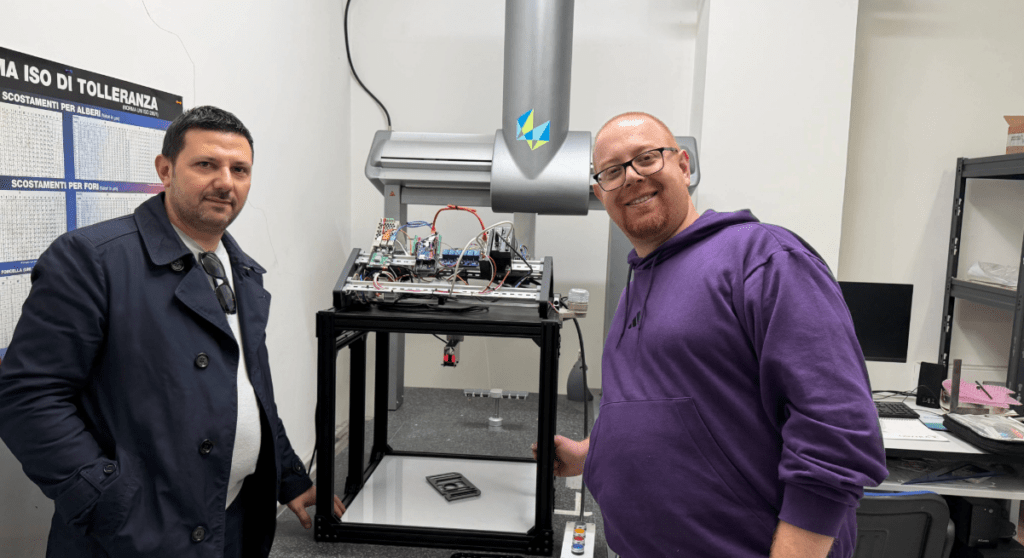
Carlo Prisco and Fabio Marchese from PriscoZen had a clear goal from the start: not a technical demo, but a real, working platform that could bring machine control, software logic, and visual quality inspection together in a single compact system. Something they could demonstrate live, evolve over time, and show that industrial automation doesn’t have to mean a traditional PLC in every scenario. The result is ZenCell – and its story is a good example of how innovation, more often than not, emerges through iterations and a progression of improvements, rather than a single eureka moment.
Where it started: Arduino®Mega board + Raspberry Pi
The first version of ZenCell was built around a practical architecture: a Mega 2560 Rev3 handling input and output signals, a Raspberry Pi as the central brain coordinating machine logic and the operating cycle, and a Keyence camera for visual inspection. Logic was distributed across two boards, but it worked – well enough that cycle times were in the range of 1.8 to 2.2 seconds.
The team tested the system first at home, validating the overall logic and machine behavior in early-stage conditions. Then they took it further: ZenCell was integrated alongside a three-axis industrial robot next to a molding press, where it held up just as well. The architecture proved its validity not just as a concept, but in conditions close to real production – and it was open, integrated, and flexible.
The shift: from two boards to one
Once the Arduino® UNO Q board was released, PriscoZen saw an opportunity to greatly improve their solution. Thanks to its dual-brain architecture, UNO Q combines an MPU running Linux with an MCU handling real-time control – exactly the split that Raspberry Pi and Mega were covering separately, now unified on a single compact platform. This allowed Prisco and Marchese to rethink how the system was organized.
In ZenCell V1 – which will début at Maker Faire Caserta 2026 (May 30-31, 2026) – UNO Q is the true engine of the system: hosting the dedicated ZenCell software, managing the cycle logic, coordinating all connected devices, and handling identification peripherals like QR code and barcode readers directly. The result is a cleaner, more centralized architecture, with cycle times brought down to a range of 0.56 to 0.68 seconds.
ZenCore: the software layer that ties it all together
Alongside the hardware evolution, Prisco and Marchese developed ZenCore – the software platform running on ZenCell V1. Accessible through a local web interface with no complex client software required, ZenCore centralizes operational supervision, workflow and recipe management, I/O signal handling, diagnostics, and vision system integration in a single environment.
The long-term vision is a node-based, visual approach to automation logic – connecting devices, commands, states, and sequences in a way that is reusable and adaptable across future applications.
The next step for ZenCell
The roadmap for ZenCell V2 takes the platform further still, with plans to replace the Keyence camera with an open industrial camera and build a proprietary pipeline for image acquisition, dataset development, and defect-recognition model training – all running locally on the next-generation platform.
From a distributed two-board prototype to a centralized system built around a single board’s dual architecture: ZenCell is a clear example of what happens when engineers with the right skills and a concrete vision find the right tools to bring it to life.
Arduino, Mega, and UNO are trademarks of registered trademarks of Arduino S.r.l.
The post ZenCell: replacing two boards with one, to build a better quality inspection solution appeared first on Arduino Blog.
Read more here: https://blog.arduino.cc/2026/05/26/zencell-replacing-two-boards-with-one-to-build-a-better-quality-inspection-solution/