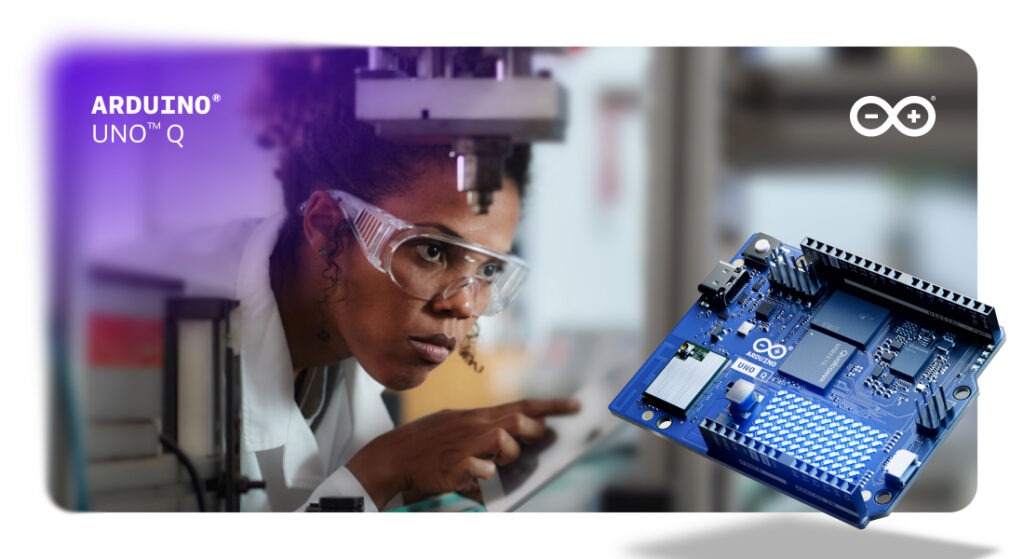
Factory lighting can be brutal. A label looks perfect from one angle and unreadable from another. A reflective pouch catches glare. A conveyor casts shadows. A package edge disappears under mixed LED lighting.
Traditional industrial vision systems solve these very real problems, and that’s why they became expensive. However, many inspection tasks don’t require a closed, high-cost smart camera. They just need a reliable prototype path: collect images, train a model, deploy locally, trigger an action, and improve.
On UNO Q, the Linux side of the board can run the camera pipeline, OpenCV preprocessing, an Edge Impulse object-detection or classification model, and a local web dashboard. Meanwhile, the MCU side can handle encoder pulses, trigger timing, stack-light outputs, and reject-actuator logic. You can already browse Arduino® Project Hub for a variety of practical vision examples that combine UNO Q with Edge Impulse models. We highly recommend the one for a robot arm that recognizes people and offers gadgets through intuitive interactions, and the one for OCR (optical character recognition) with a two-stage text detection and recognition pipeline running locally with Arduino® App Lab, plus image classification examples using a USB webcam and Edge Impulse Linux runner.
Real-world industrial applications are within reach
Imagine the following setup: a small conveyor rig with an overhead camera pointed at the product as it passes through an end-of-line station. A quantized model running locally detects pass/fail – checking for the right label, a properly seated connector, a sealed cap, or a surface defect – with inference times under 50 ms. The microprocessor running Debian hosts the dashboard made with Python and logs every result; the MCU triggers the operator’s alert system without waiting for a round trip to the cloud. No frames leave the board, no proprietary software license is required, and the same fixture can be reconfigured for a different product without rearchitecting the system from scratch. Sound like a dream? Nope, it’s real: just check up the setup IDT Solution validated in their open-architecture AOI proof of concept for automotive end-of-line inspection.
Want to learn even more? You can also use the UNO Q to run a defect classification model, such as a missing label, wrong color, missing cap, or damaged package. Train the first model in Edge Impulse. Deploy through Arduino App Lab. Run the application as a Debian service or Arduino App Lab app. Use the MCU for deterministic reject timing.
UNO Q turns vision into action
UNO Q has the potential to become the leading SBC for its price and power category, because of the real value it offers.
1. Industrial vision without industrial pricing. Build credible inspection prototypes without committing to proprietary smart-camera systems.
2. Better inspection under real lighting. Use multiple camera views, local preprocessing, and optimized vision models to improve robustness under glare, shadow, and reflective surfaces.
3. AI plus deterministic action. Run inference on Linux; trigger conveyors, lights, and reject mechanisms through the MCU.
The real promise of UNO Q is not just that it can run a vision model. It is that it can turn vision into action.
A traditional camera can capture an image. A cloud model can classify it later. But an industrial inspection system needs more than recognition. It needs timing, reliability, local decision-making, and a way to respond immediately when something is wrong.
Edge AI for machine vision: from concept to working prototype
By combining Debian Linux, Edge Impulse, local AI inference, and deterministic MCU control, developers can build inspection systems that see the product, understand the defect, log the result, and trigger a physical response – all at the edge.
This means a faster path from concept to working prototype. For developers, it means open tools, flexible deployment, and real-world control. For manufacturers, it means machine vision can move beyond expensive, closed systems and become something more accessible, adaptable, and scalable.
That is how industrial vision becomes practical, repeatable, and affordable – and it is exactly the kind of edge AI workflow UNO Q was built to unlock.
Ready to build your first AI camera inspection system? Explore UNO Q and start prototyping real-world inspection systems today.
Arduino, UNO and the Arduino logo are trademarks or registered trademarks of Arduino S.r.l.
The post Industrial-grade vision inspection, made accessible by the Arduino® UNO™ Q board appeared first on Arduino Blog.
Read more here: https://blog.arduino.cc/2026/05/28/industrial-grade-vision-inspection-made-accessible-by-the-arduino-uno-q-board/