Artificial intelligence has already evolved from simple conversational assistants into autonomous systems capable of interacting with software, hardware, sensors, and even the physical world. The next frontier is not simply “chatting” with AI, but enabling AI agents to observe, reason, decide, and execute actions locally at the edge.
This shift becomes particularly interesting when combined with embedded systems. Why? Because traditionally, embedded development required deterministic programming, fixed automation logic, and carefully predefined behaviors. But now AI systems are capable of dynamically generating code, controlling peripherals, interacting with operating systems, and adapting behavior in real time. And we see all of this happening in projects built around the Arduino® UNO Q board.
“Think local” takes on a whole new meaning
What makes this especially compelling is that these agents can run locally.
Instead of relying entirely on cloud APIs and remote inference, developers are beginning to deploy autonomous AI systems directly on edge devices – reducing latency, improving privacy, lowering operational costs, and enabling offline functionality. Projects such as QClaw and the broader OpenClaw ecosystem are demonstrating how this model can work on UNO Q.
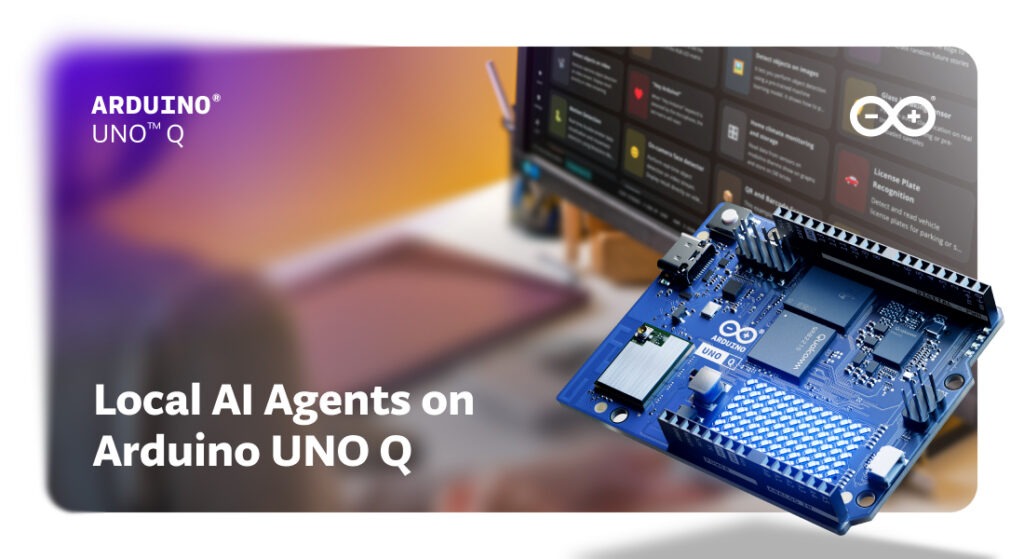
Our first dual-brain board is particularly well suited for this new generation of AI-native embedded simple systems because it combines two different computing worlds on the same platform. In simple words, this means you have one board where, on one side, there is a Linux-capable Qualcomm Dragonwing QRB2210 processor capable of running Python applications, Docker containers, networking stacks. On the other side, an STM32 microcontroller handles deterministic real-time operations such as GPIO access, peripheral control, and low-level hardware timing. This hybrid architecture allows developers to separate high-level reasoning from low-level execution, effectively creating systems where AI can “think” on Linux while the microcontroller interacts directly with the physical environment.
Your word is AI’s command
One of the most interesting frameworks emerging in this space is OpenClaw. Rather than being a language model itself, OpenClaw acts as an orchestration layer that connects large language models with tools, terminals, filesystems, APIs, and hardware interfaces. As described in the OpenClaw installation guide for Qualcomm®and Arduino®platforms, the framework enables AI models to move beyond pure text generation and become actionable agents capable of executing commands and interacting with their environment.
This changes the relationship between developers and embedded systems faster than ever. Instead of manually writing every line of code, users can increasingly interact with hardware through natural language. We’ve already showcased a good example of this approach here, demonstrating how OpenClaw can run on UNO Q to use conversational prompts to control hardware directly. Rather than opening an IDE and programming peripherals manually, you can ask the agent to blink LEDs, modify animations on the LED matrix, or generate entirely new interactions dynamically.
What makes these demonstrations powerful is the iterative workflow they enable. In one example, the AI agent generated code to display graphics on the LED matrix, uploaded the firmware, and then refined the visual output interactively through additional prompts. The interface to embedded systems effectively becomes conversational. Hardware prototyping starts looking less like firmware engineering and more like collaborative interaction with an intelligent assistant.
Fast, private, cheap AI agents? Cutting edge!
This concept evolves even further in the QClaw project, where the Arduino UNO Q becomes a fully local agentic assistant. In this architecture, the system is capable not only of generating code, but also of compiling sketches, uploading the compiled code, interacting with local services, and managing workflows autonomously. Within this scenario, the agent orchestrates the full pipeline from intent to execution.
An especially interesting direction is the growing trend toward fully local AI deployments. While many AI systems depend heavily on cloud-hosted models, several developers are exploring combinations of OpenClaw with Ollama and lightweight open-source LLMs to build completely offline agents. The article How to turn OpenClaw into a real Arduino agent using a free local LLM demonstrates how developers can run local inference directly on the device without sending prompts or data to external APIs. In this model, Ollama hosts the local language model while OpenClaw orchestrates tools and actions, allowing UNO Q to function as an autonomous AI node entirely within the local network.
This approach is particularly attractive for edge AI applications because it addresses many of the practical concerns associated with cloud AI. Sensitive data remains local, recurring API costs disappear, internet connectivity becomes optional, and response times improve significantly. Of course, local models are generally smaller and less capable than frontier cloud models, but for many embedded automation tasks the tradeoff is worthwhile. In fact, for hardware-centric workflows, deterministic execution and local responsiveness often matter more than absolute model intelligence.
Local AI meets the real world
The implications become even more interesting when AI agents start interacting with sensors and perception systems. A compelling example comes from this AI-powered gas stove monitoring project, where computer vision and local AI reasoning were combined to monitor kitchen burners and detect potentially dangerous situations. Instead of relying on rigid rule-based automation, the AI system interpreted contextual visual information and made decisions dynamically.
This is an important shift because it demonstrates how edge AI agents can combine perception, reasoning, and physical interaction into unified systems capable of operating in real environments.
Safety first! Let UNO Q be your “hardware sandbox”
What emerges from all these projects is a broader transformation in how embedded systems may be designed in the future and how UNO Q allows this shift, acting as an accelerator.
Traditionally, embedded devices were deterministic endpoints executing carefully predefined logic. AI agents introduce adaptability. Developers no longer need to explicitly define every possible branch of execution. Instead, they can define goals, permissions, tools, and constraints, allowing the agent to determine dynamically how tasks should be completed.
This does not eliminate traditional engineering. Rather, it shifts engineering effort toward architecture, orchestration, safety, and supervision. The challenge becomes designing systems where AI agents can act autonomously while remaining constrained, secure, and reliable.
Security is in fact one of the most important considerations in this new paradigm. AI agents often gain access to terminals, filesystems, APIs, and hardware interfaces, which introduces entirely new attack surfaces. One advantage of platforms such as UNO Q is the possibility of creating isolated “hardware sandboxes” dedicated to agent execution. Instead of granting AI systems unrestricted access to personal laptops or production environments, developers can deploy agents on dedicated edge hardware with limited permissions and compartmentalized resources. This physical separation is one of the most important deployment strategies for safe personal AI agents.
The bigger picture
The broader trend is clear: AI is moving toward the edge, becoming increasingly autonomous, multimodal, and physically interactive. UNO Q plays a relevant role not because it replaces cloud AI, but because it makes AI tangible – empowering developers, makers, researchers, and students to experiment with autonomous embedded intelligence locally, affordably, and safely.
Ready to upgrade from chatbots to autonomous embedded collaborators? Get your hands on UNO Q and play an active role in the AI revolution!
Qualcomm branded products are products of Qualcomm Technologies, Inc. and/or its subsidiaries. Arduino, and UNO, and the Arduino logo are trademarks or registered trademarks of Arduino S.r.l.
The post Local AI agents on Arduino UNO Q appeared first on Arduino Blog.
Read more here: https://blog.arduino.cc/2026/06/09/local-ai-agents-on-arduino-uno-q/