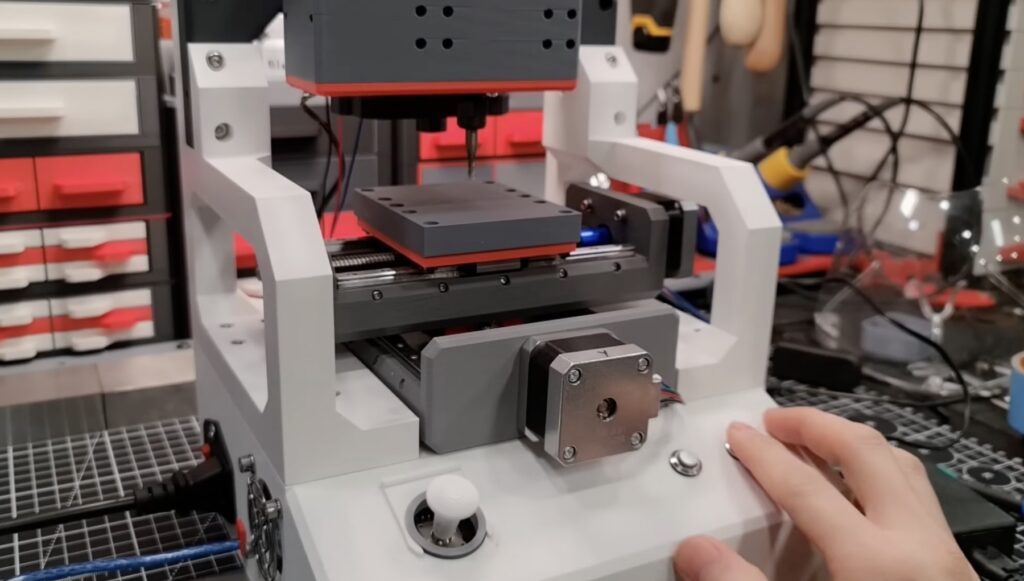
In the automotive industry, “drive-by-wire” means that a traditionally mechanical linkage, like a throttle cable, has been replaced by an electronic actuator. That can eliminate design constraints and even save money. SciFientist was able to apply those same drive-by-wire principles to this 3D-printed micro milling machine.
Machine tools, including vertical mills, are usually either CNC, manual, or power-assisted. In that last scenario, there is usually a simple motor that rotates a lead screw, so the user doesn’t have to crank the handle a bunch of times to traverse long distances. The motor can feed more consistently than a person can as well.
But this 3D-printed micro mill is different, because it entirely replaces the traditional manual cranks with motors and can only be controlled electronically — just like a drive-by-wire car.
Each axis has a lead screw turned by a stepper motor, controlled by an Arduino UNO Rev3 with a CNC Shield. The Arduino moves the motors in response to user input through a joystick and buttons. But in this incarnation, there isn’t any provision for true CNC operation — though SciFientist has plans for a second version with that capability.
What also stands out about this micro mill is its 3D-printed frame. That isn’t rigid at all by machine tool standards, but it should be good enough for the PCB milling that SciFientist plans to tackle with the machine.
While this is just the first step on the way to more conventional CNC milling, the drive-by-wire control is interesting. With linear position feedback on each axis — essentially a DRO— and fine motor movement, it would allow for many of the benefits of manual milling, but in a compact and affordable package that ignores the design constraints of manual mills.
The post A 3D-printed “drive-by-wire” micro mill for your desktop appeared first on Arduino Blog.
Read more here: https://blog.arduino.cc/2026/04/15/a-3d-printed-drive-by-wire-micro-mill-for-your-desktop/