Picking the right technology topics for a presentation in 2026 can feel like a big task. Things change so fast, right? You want something that feels current, something that people will actually pay attention to. Forget those old, tired subjects. We’re looking at what’s new, what’s next, and what’s actually happening in the world of tech. This list is here to help you find that perfect subject, whether you’re a student or just someone who needs to talk about tech.
Key Takeaways
- Generative AI and agentic systems are changing how we create and automate tasks, offering new possibilities for content creation and task management.
- Quantum computing, though complex, holds the potential to revolutionize industries by solving problems currently impossible for classical computers.
- Cybersecurity is moving towards proactive measures like zero-trust models and privacy-first design to protect against evolving digital threats.
- The future of work involves a blend of human-tech interaction, with AI playing a significant role in collaboration, skills development, and HR.
- Immersive technologies like XR and digital twins are creating new ways to train, design, and monitor systems, blurring the lines between the physical and digital worlds.
The Evolving Landscape Of Artificial Intelligence
Artificial Intelligence (AI) continues its rapid development, moving beyond theoretical concepts into practical applications that are reshaping industries and daily life. As we look towards 2026, the focus is shifting towards more sophisticated and integrated AI systems. This evolution presents exciting opportunities for presentations, allowing you to explore cutting-edge advancements and their real-world impact.
Generative AI and Its Creative Potential
Generative AI has moved from a niche interest to a mainstream phenomenon. These systems are now capable of creating a wide array of content, from text and images to music and even code. For presentations, you can explore how generative AI is being used in fields like marketing for personalized ad campaigns, in architecture for design visualization, and in software development for code generation. It’s also transforming creative industries, enabling artists and designers to explore new forms of expression. The ability of AI to generate novel content is opening up unprecedented avenues for creativity and efficiency.
Here are some areas to consider:
- Content Creation: Discuss AI’s role in generating articles, scripts, and marketing copy.
- Art and Design: Showcase AI-generated visuals, music, and their impact on creative workflows.
- Software Development: Explore how AI assists in writing, debugging, and optimizing code.
- Personalization: Examine AI’s use in tailoring experiences, from product recommendations to educational materials.
Agentic AI Systems: The Future of Automation
Beyond simply generating content, AI is increasingly being developed into agentic systems. These are AI agents designed to perform tasks autonomously, often in complex environments. Think of AI assistants that can manage schedules, book appointments, or even conduct research with minimal human oversight. In transportation, agentic AI is powering autonomous fleets and optimizing logistics. For presentations, you can discuss the potential of these systems to automate routine tasks, improve decision-making, and create more efficient workflows across various sectors.
Consider these points for your presentation:
- Autonomous Operations: How AI agents are managing systems in logistics, manufacturing, and customer service.
- Decision Support: AI agents assisting in complex decision-making processes in finance or healthcare.
- Task Automation: Examples of AI agents handling repetitive or complex tasks, freeing up human workers.
- Human-AI Collaboration: The evolving relationship between humans and autonomous AI agents.
The development of agentic AI systems signifies a move towards AI that doesn’t just process information but actively interacts with and influences its environment to achieve goals. This shift has profound implications for how we structure work and manage complex systems.
Ethical Considerations in AI Development
As AI becomes more powerful and pervasive, the ethical implications of its development and deployment are more important than ever. Discussions around AI in 2026 must include topics like bias in algorithms, the potential for misuse (such as deepfakes), and the impact on employment. Presentations can explore the frameworks and principles being developed to ensure AI is used responsibly and equitably. Addressing these concerns is not just a matter of compliance but of building trust and ensuring AI benefits society as a whole.
Key ethical areas to cover:
- Algorithmic Bias: How biases in data can lead to unfair outcomes and methods to mitigate them.
- Privacy Concerns: The implications of AI systems collecting and analyzing vast amounts of personal data.
- Transparency and Explainability: The challenge of understanding how complex AI models arrive at their decisions.
- Societal Impact: The effects of AI on jobs, inequality, and human interaction.
Advancements In Quantum Computing And Its Applications
Quantum Computing Explained For Broader Audiences
Quantum computing is a pretty wild idea that’s been around for a while, but it’s really starting to gain traction. Unlike the computers we use every day, which store information as bits that are either a 0 or a 1, quantum computers use ‘qubits.’ These qubits can be a 0, a 1, or, thanks to a quantum phenomenon called superposition, both at the same time. This might sound a bit abstract, but it’s what gives quantum computers their incredible potential power. Think of it like this: a regular computer checks one path at a time to solve a maze, while a quantum computer can explore many paths simultaneously. This allows them to tackle problems that are currently impossible for even the most powerful supercomputers.
Potential Impact Of Quantum Computing On Industries
The implications of quantum computing are vast and could reshape many sectors. For instance, in medicine, it could speed up the discovery of new drugs and treatments by simulating molecular interactions with unprecedented accuracy. Imagine designing personalized medicines based on an individual’s genetic makeup, something that’s incredibly complex with current technology. In finance, quantum computers could optimize investment portfolios and detect fraud more effectively. Materials science is another area ripe for disruption, with the potential to design new materials with specific properties, like lighter, stronger alloys or more efficient catalysts for industrial processes.
Here are a few key areas where quantum computing is expected to make a significant impact:
- Drug Discovery and Development: Simulating molecular behavior to find new pharmaceuticals.
- Financial Modeling: Optimizing trading strategies and risk management.
- Materials Science: Creating novel materials with tailored characteristics.
- Logistics and Optimization: Solving complex routing and scheduling problems.
The Road To Practical Quantum Computing
While the potential is exciting, we’re still on a journey to fully realize practical quantum computing. Building and maintaining quantum computers is incredibly challenging. Qubits are very sensitive to their environment, and even tiny disturbances like heat or vibrations can cause errors. This means quantum computers often need to be kept at extremely low temperatures, close to absolute zero, and shielded from external interference. Researchers are actively working on improving qubit stability, developing error correction techniques, and scaling up the number of qubits in a system. The development of fault-tolerant quantum computers is the next major hurdle. It’s a complex engineering and scientific challenge, but progress is being made steadily, with companies and research institutions around the world investing heavily in this future technology.
Securing Our Digital World: Cybersecurity Trends
Zero-Trust Security Architectures In Practice
In today’s interconnected world, the old way of thinking about network security – where everything inside the network perimeter was trusted – just doesn’t cut it anymore. We’re seeing a big shift towards ‘zero-trust’ models. This approach basically means that no user or device is trusted by default, even if they’re already inside the network. Every single access request has to be verified, every time. It’s like having a bouncer at every door, not just the front gate.
This means implementing strong identity verification, like multi-factor authentication, and strictly controlling access based on the principle of least privilege. Devices are also continuously monitored for any suspicious activity. It’s a more robust way to protect sensitive data from both external threats and internal misuse.
Navigating IoT Security Challenges
The Internet of Things (IoT) has brought incredible convenience, connecting everything from our smart thermostats to industrial sensors. But this explosion of connected devices also opens up a lot of new security holes. Many IoT devices weren’t designed with security as a top priority, making them easy targets for attackers. Think about a compromised smart camera being used to spy on a home, or a network of hacked devices launching a denial-of-service attack.
Addressing these challenges requires a multi-pronged strategy:
- Device Hardening: Manufacturers need to build security into devices from the ground up, using strong passwords and secure update mechanisms.
- Network Segmentation: Isolating IoT devices on separate networks can limit the damage if one gets compromised.
- Continuous Monitoring: Keeping an eye on IoT device traffic for unusual patterns can help detect breaches early.
- Regular Updates: Just like your phone or computer, IoT devices need software updates to patch security vulnerabilities.
The sheer volume and diversity of IoT devices present a unique challenge. Unlike traditional IT systems, managing security for millions of small, often low-power devices requires new approaches and tools. It’s a complex puzzle that organizations are still working to solve.
Privacy-First Product Design Principles
As people become more aware of how their data is used, companies are realizing that building products with privacy in mind from the start is no longer optional – it’s a competitive advantage. This ‘privacy-first’ approach means that user privacy isn’t an afterthought; it’s a core design requirement. It involves minimizing data collection, being transparent about data usage, and giving users control over their information.
Key principles include:
- Data Minimization: Only collect the data that is absolutely necessary for the product to function.
- Purpose Limitation: Use collected data only for the specific, stated purposes.
- User Control: Provide clear options for users to manage their data and privacy settings.
- Transparency: Clearly communicate what data is collected, why, and how it’s protected.
This shift is driven by both user demand and increasing regulatory pressure, making it a vital consideration for any new technology development in 2026.
The Future Of Work And Human-Tech Interaction

The way we work is changing, and technology is at the heart of it all. In 2026, we’re seeing a big shift in how people and machines work together, making things more efficient and, hopefully, more enjoyable. This isn’t just about new gadgets; it’s about rethinking our entire work environment.
Hybrid Work Models And Collaboration Tools
Hybrid work, where people split their time between the office and home, is becoming the norm. This setup needs tools that help everyone stay connected, no matter where they are. Think about video conferencing that feels like you’re in the same room, or digital whiteboards where teams can brainstorm together in real-time. These tools are key to making sure that collaboration doesn’t suffer just because people aren’t physically together.
Here are some ways technology is supporting hybrid work:
- Advanced Communication Platforms: Tools that go beyond simple chat, offering integrated video, project management, and document sharing.
- Virtual Collaboration Spaces: Digital environments where teams can meet, interact, and work on projects as if they were in a shared physical space.
- Smart Scheduling Tools: Software that helps manage calendars and find meeting times that work for everyone, considering different time zones and work preferences.
Essential Digital Skills For The Modern Workforce
As technology evolves, so do the skills needed to keep up. It’s not just about knowing how to use a computer anymore. People need to be comfortable with new software, understand data, and be able to adapt quickly to new digital tools. This means continuous learning is a must.
- Data Literacy: Understanding how to read, interpret, and use data to make decisions.
- Digital Collaboration: Proficiency in using online tools to work effectively with others.
- Adaptability and Learning Agility: The willingness and ability to learn new technologies and processes quickly.
The pace of technological change means that skills acquired today might be outdated tomorrow. A mindset focused on continuous learning is more important than ever for career longevity.
AI’s Role In Human Resources Management
Artificial intelligence is starting to play a bigger part in HR. It can help with tasks like sifting through job applications, scheduling interviews, and even analyzing employee feedback to spot trends. The goal is to free up HR professionals to focus on more human-centric aspects of their jobs, like employee well-being and development. While AI can handle a lot of the repetitive work, the human touch remains vital for building a positive workplace culture.
Immersive Technologies: XR, Spatial Computing, And Digital Twins
The lines between our physical and digital worlds are blurring, thanks to exciting advancements in immersive technologies. We’re talking about Extended Reality (XR), Spatial Computing, and Digital Twins – tools that are moving beyond niche applications and into mainstream use cases. These technologies aren’t just about entertainment; they’re reshaping how we learn, work, and interact with information.
Extended Reality for Training and Skill Development
Extended Reality, which encompasses Virtual Reality (VR), Augmented Reality (AR), and Mixed Reality (MR), offers incredibly powerful ways to train people. Imagine surgeons practicing complex procedures in a risk-free virtual environment before touching a real patient. Or mechanics learning to repair intricate machinery through AR overlays that guide their every move. This approach allows for hands-on experience without real-world consequences, making learning more effective and retention higher. It’s a safe space to make mistakes and learn from them.
- VR for skills training: Provides safe, repeatable practice environments.
- AR for guided assistance: Overlays digital information onto the physical world.
- MR for interactive learning: Blends digital and physical elements for richer experiences.
Spatial Computing in Design and Collaboration
Spatial computing is the next frontier, allowing us to interact with digital information in 3D space. Think of architects walking through a building design before it’s even built, or product designers manipulating 3D models collaboratively in a shared virtual space. This technology makes complex data more intuitive and accessible. It’s about making digital information feel as real and tangible as the objects around us. This can really speed up the design process and catch issues early on.
Spatial computing is fundamentally changing how we perceive and interact with digital content, moving it from flat screens into the three-dimensional world we inhabit.
Digital Twins for Predictive Maintenance and Healthcare
Digital Twins are virtual replicas of physical objects, processes, or systems. They are incredibly useful for predicting issues before they happen. For example, a digital twin of a jet engine can monitor its performance in real-time, flagging potential problems long before they lead to a breakdown. In healthcare, digital twins of patients can help doctors personalize treatment plans and simulate the effects of different therapies. This proactive approach saves time, money, and, most importantly, lives. The potential for predictive maintenance is vast across many industries.
- Manufacturing: Monitoring equipment for early failure detection.
- Healthcare: Simulating patient responses to treatments.
- Urban Planning: Modeling city infrastructure for efficiency and resilience.
These immersive technologies are no longer science fiction; they are practical tools that are driving innovation and changing our world in profound ways.
Biotechnology And Health Tech Innovations
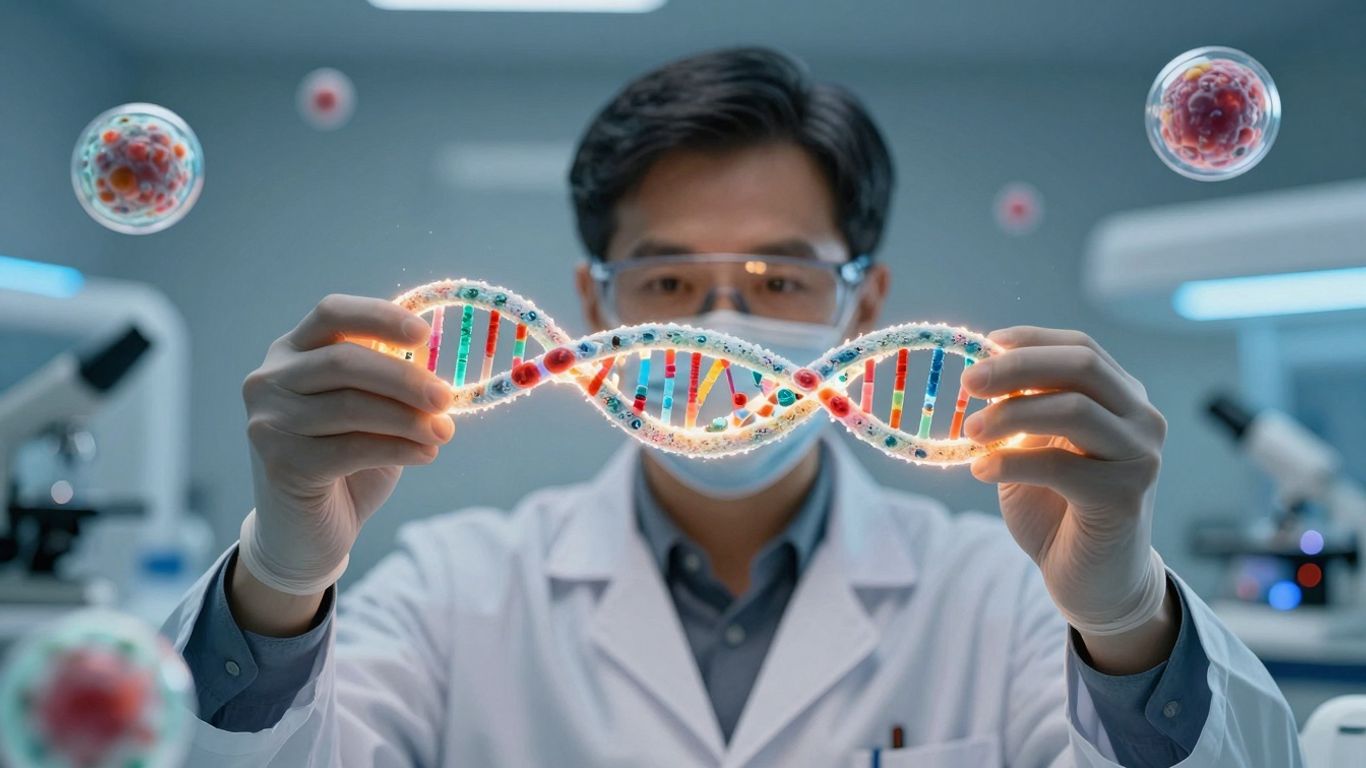
The fields of biotechnology and health technology are rapidly changing how we approach wellness and medical treatment. It’s not just about new medicines anymore; it’s about understanding our bodies at a deeper level and using technology to personalize care. Think about how far we’ve come from one-size-fits-all approaches. Now, we’re looking at treatments tailored to our unique genetic makeup and using smart tools to catch problems before they even start.
Personalized Medicine Through Genomics
Genomics is a game-changer. By studying an individual’s complete set of DNA, scientists and doctors can get a much clearer picture of their health risks and how they might respond to different treatments. This means moving away from trial-and-error and towards therapies that are more likely to work from the get-go. It’s about using your genetic blueprint to guide your healthcare.
AI’s Impact On Medical Diagnostics
Artificial intelligence is becoming an indispensable partner in diagnosing illnesses. AI algorithms can analyze medical images, like X-rays and MRIs, with incredible speed and accuracy, often spotting subtle signs that might be missed by the human eye. This speeds up the diagnostic process significantly, allowing for earlier intervention and better patient outcomes.
Here’s a look at how AI is making a difference:
- Image Analysis: Identifying anomalies in scans.
- Predictive Analytics: Forecasting disease progression based on patient data.
- Drug Discovery: Accelerating the identification of potential new treatments.
The integration of AI into diagnostics isn’t about replacing healthcare professionals but about providing them with powerful tools to make more informed decisions, faster.
The Role Of Nanomedicine In Treatment
Nanomedicine takes advantage of incredibly small particles, measured in nanometers, to deliver treatments directly to specific cells or tissues within the body. This precision can lead to more effective therapies with fewer side effects. Imagine tiny robots or specially designed nanoparticles carrying medication exactly where it’s needed, like targeting cancer cells while leaving healthy ones unharmed. This targeted approach is a significant step forward in making treatments more efficient and less burdensome for patients.
Sustainable Technology For A Greener Future
The push for a healthier planet is no longer a niche concern; it’s a global imperative. Technology plays a massive role in this shift, offering innovative ways to reduce our environmental footprint and build a more sustainable world. We’re seeing breakthroughs across various sectors, from how we generate energy to how we manage our resources.
Innovations In Renewable Energy Sources
Renewable energy is at the forefront of sustainability. Solar and wind power continue to advance, becoming more efficient and cost-effective. Beyond these, we’re exploring new frontiers like advanced geothermal systems that tap into the Earth’s heat more effectively and green hydrogen production, which uses renewable electricity to create a clean fuel source. These technologies are key to moving away from fossil fuels and reducing greenhouse gas emissions. The future of energy is undeniably renewable.
- Solar Power Advancements: New photovoltaic materials and designs are increasing energy capture even in less-than-ideal conditions.
- Wind Turbine Engineering: Larger, more aerodynamic turbines are being developed to capture more wind energy, even at lower speeds.
- Green Hydrogen: Electrolysis powered by renewables creates hydrogen without carbon emissions, offering a versatile clean fuel.
- Geothermal Energy: Innovations in drilling and extraction are making it possible to access geothermal heat in more locations.
Carbon Capture And Storage Technologies
Even as we transition to renewables, existing industries produce carbon emissions. Carbon capture and storage (CCS) technologies offer a way to mitigate this. These systems capture carbon dioxide directly from industrial sources or even from the atmosphere. The captured CO2 can then be stored underground or used in other industrial processes. While still developing, CCS is seen as a vital tool for hard-to-decarbonize sectors.
The development and widespread adoption of carbon capture technologies are critical for meeting ambitious climate goals, especially for industries where direct emission reduction is challenging.
Smart Systems For Eco-Friendly Buildings
Buildings consume a significant amount of energy. Smart building systems use technology to optimize energy use for heating, cooling, lighting, and ventilation. These systems can learn occupancy patterns, adjust settings automatically, and integrate with renewable energy sources. The result is reduced energy waste, lower utility bills, and a smaller environmental impact. This approach is transforming how we design, construct, and operate our living and working spaces, making them more efficient and comfortable. For those looking to secure their digital infrastructure, understanding how cloud services operate and prioritizing data privacy are key aspects of a secure strategy, much like eco-friendly buildings prioritize resource efficiency [0d7f].
Wrapping Up Your Tech Presentation Journey
Choosing the right topic is a big part of making a presentation that people will remember. It’s your chance to share something you find interesting and teach others something new. We’ve looked at a lot of exciting technology areas for 2026, from AI and quantum computing to clean energy and the future of work. Remember to pick something that genuinely sparks your curiosity and that you can explain clearly. Don’t forget that tools are available to help you build your slides, so you can focus on your message. With a great topic and a clear plan, your next presentation is sure to be a success.
Frequently Asked Questions
What is Generative AI and why is it important for presentations?
Generative AI is like a super-smart computer program that can create new things, such as pictures, music, or even stories. For presentations, it means you can use AI to help you come up with cool ideas or even generate parts of your presentation, making it more unique and engaging for your audience in 2026.
How can quantum computing be explained to someone who doesn’t know much about it?
Imagine a regular computer uses bits that are like light switches, either on or off. Quantum computers use ‘qubits’ which can be on, off, or both at the same time! This lets them solve really hard problems much faster, which could change how we do things in science and business.
What does ‘Zero-Trust Security’ mean for protecting our information?
Normally, we trust things once they are inside our computer network. Zero-Trust means we don’t trust anything automatically, even if it’s already inside. Every time something tries to access information, it has to prove who it is, like showing an ID every time you enter a room. This makes it much harder for bad actors to get in.
How is technology changing the way we work in 2026?
Technology is making work more flexible. Tools help people work together even if they are in different places, like using virtual meeting rooms. Also, AI is helping with tasks like finding new employees or making sure everyone has the right computer skills to do their jobs well.
What are ‘Digital Twins’ and how are they used?
A digital twin is like a virtual copy of a real thing, like a machine or even a whole building. By having this copy, people can test things out or predict when something might break without messing with the real thing. This is super helpful for keeping things running smoothly and preventing problems.
How is technology helping us get healthier?
New health tech is making medicine more personal. For example, by looking at your unique body code (your genes), doctors can figure out the best way to treat you. Also, AI can help doctors spot illnesses faster by looking at scans, and tiny robots (nanomedicine) can help deliver medicine right where it’s needed in the body.
The post Engage Your Audience: Fresh Technology Topics for Presentations in 2026 appeared first on IntelligentHQ.
Read more here: https://www.intelligenthq.com/technology-topics-for-presentation-2/