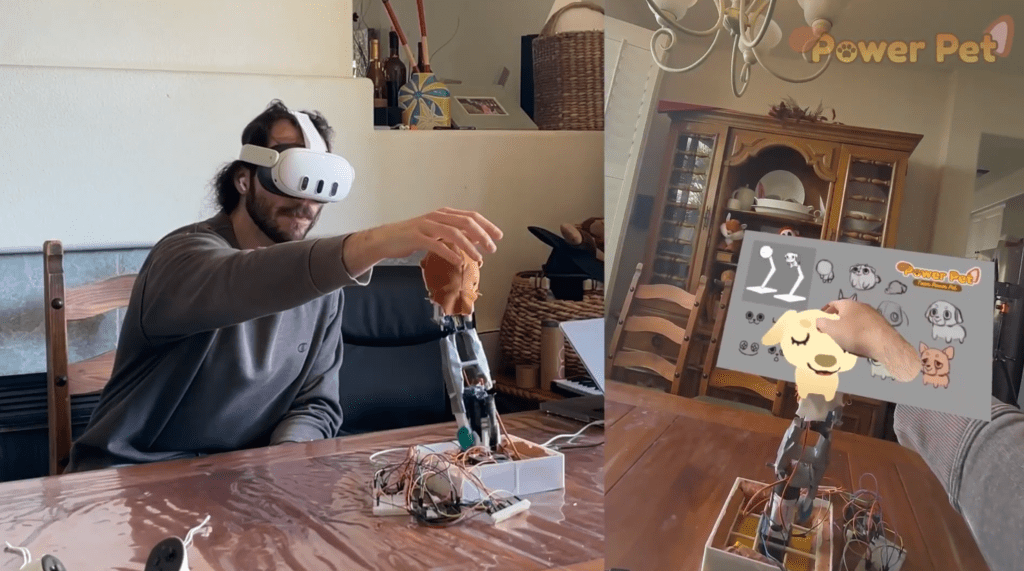
What if your virtual pet wasn’t just pixels on a screen, but something you could actually reach out and touch? A team at Reality Hack @ MIT 2026 made that idea real with Power Pet – a hybrid VR and physical companion that bridges the digital and tactile worlds using Arduino® UNO Q, hand tracking on Meta Quest 3, and a responsive robotic arm.
The project tackles something many of us can relate to: staying focused and emotionally regulated in an increasingly overwhelming world. But instead of adding more notifications or productivity pressure, Power Pet offers a calming presence that responds to you in both virtual reality and the real world. Pat the virtual pet on the head? The physical one tilts toward you. Step closer? Both versions respond with expressive eye contact and gentle animations.
How virtual becomes tangible
The team built the entire system using UNO Q at its core, taking advantage of the board’s hybrid MPU and MCU architecture: the Linux side handles networking via Python® and WebSockets, while the microcontroller manages real-time motor control for the stepper motors and servos. This division of labor – networking on one processor, time-critical hardware control on the other – allowed them to synchronize VR state and physical movement reliably without jitter.
Designed for focus, not stress
The inspiration behind Power Pet came from lived experience with neurodivergence and working directly with autistic individuals, where the team saw how sensory regulation and emotional support can dramatically affect focus and comfort. They were inspired by research showing that companion animals reduce stress and increase productivity – but without the barriers of cost, care requirements, and unpredictability.
What’s next: meditation, LLMs, and scent cues
The team has a lot of ideas of how Power Pet could be expanded in the future. They envision adding guided meditation to help users ground themselves, LLM-powered chat for when users feel stuck, and a shop system where progress unlocks skins and accessories for customization. Further exploration could involve additional sensory channels, like scent cues (aroma) and integrating real-world context using Arduino® Modulino sensors to detect stress proxies like temperature changes or fidgeting – and trigger calming behaviors in response.
When hardware meets heart
Power Pet is a beautiful example of what happens when technology serves human needs rather than the other way around: the team created something that’s both technically impressive and genuinely comforting.You can explore the project in detail, including code and documentation, on the Power Pet Devpost page. Check it out to find out more about the technical implementation, the research behind emotional regulation, or just curious about the future of tangible XR companions!
The post Power Pet: a VR companion at your side appeared first on Arduino Blog.
Read more here: https://blog.arduino.cc/2026/04/28/power-pet-a-vr-companion-at-your-side/