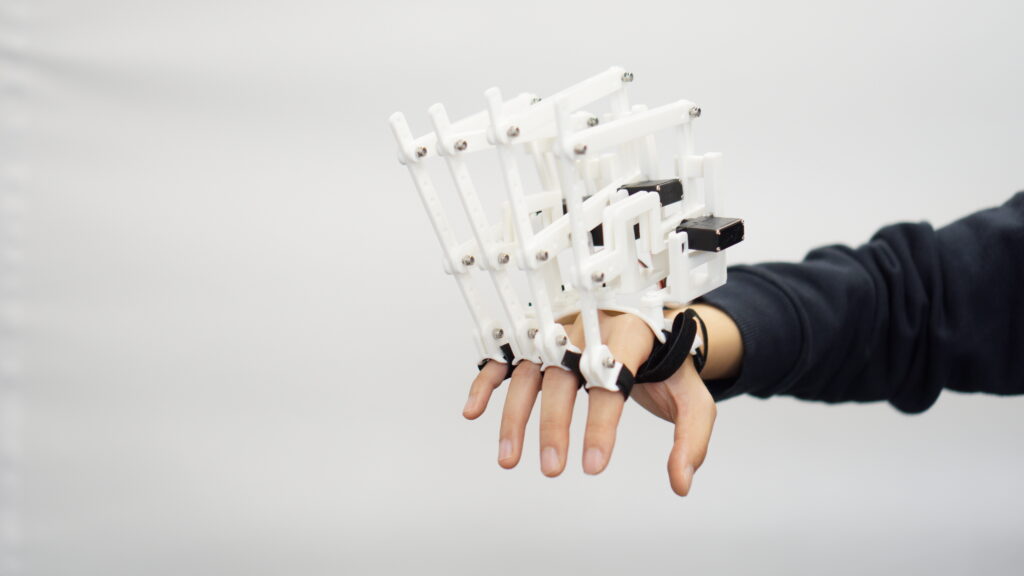
Learning to play the piano is hard. Your fingers need to find the right keys, apply the right pressure, and move in precise sequences – all while your brain tries to translate sheet music into muscle memory. What if your hands could learn faster with a teacher that literally guides them through each movement?
That’s the vision behind Hapticus, a research project led by Kyungyeon Lee, a PhD student at the University of Maryland. Presented at both CHI 2025 and SIGGRAPH Asia 2025 Emerging Technologies. Hapticus is rewriting the rules of how we think about motor skill learning. And at the heart of this innovation? The Arduino® Nano 33 BLE board!
When touch becomes teaching
Kyungyeon’s research tackles a fundamental challenge: everyone learns motor skills differently. Some people respond better to gentle vibrations guiding their movements. Others benefit from mechanical assistance that physically moves their hands through the correct motions. Others yet learn best when their muscles are subtly activated using electrical stimulation – a technique called EMS (Electrical Muscle Stimulation).
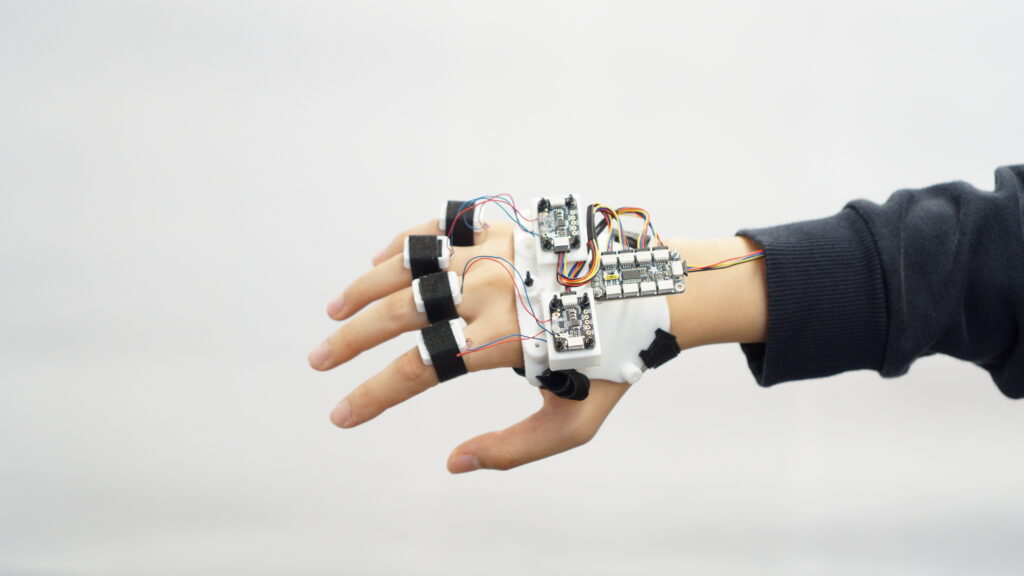
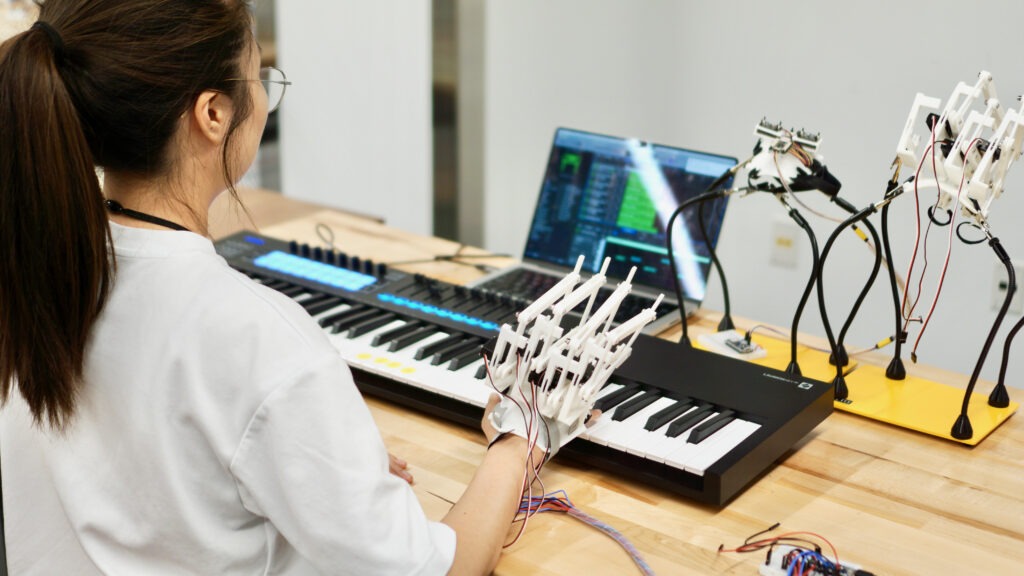
Hapticus combines all three approaches into an integrated system: a vibrotactile glove that provides tactile feedback, a mechanical linkage-based exoskeleton that guides physical movement, and an EMS device that activates muscles directly. The entire device weighs just 309 grams and is controlled by our very own Nano 33 BLE.
But here’s where it gets really clever: Hapticus includes a customization tool with presets synthesized from performance data and user feedback. As you practice (in this case, learning to play piano), the system learns which type of haptic feedback works best for you, adapting in real-time to optimize your learning experience. It’s personalized motor skill training, powered by accessible open-source hardware.
Why Arduino? Speed, reliability, and freedom to iterate
Kyungyeon says she and her team chose Arduino for such advanced research, “because it let us move quickly from concept to working, study-ready hardware. For haptics research, we needed precise timing, reliable actuation, and tight integration with sensors and motors, and Arduino provided low-level control without slowing iteration, while also offering several well-documented examples. That balance was critical for building multiple wearable prototypes and running controlled user studies.” That’s exactly our goal at Arduino: get any complexities out of the way, and let the innovation happen!
Once the project started, Kyungyeon knew they had made the right choice. “Arduino has been stable and flexible throughout the project. We used it across several custom devices (EMS, mechanical linkage exoskeleton, and vibrotactile glove), and it handled real-time control reliably even in long experimental sessions. Its ecosystem also made debugging, calibration, and rapid redesign much easier during research-driven iteration.”
In addition, Nano 33 BLE’s compact size meant it could be integrated into a wearable system without adding bulk.
From prototype to publication
Hapticus has been peer-reviewed and accepted at CHI 2025 (the premier conference for human-computer interaction research) and SIGGRAPH Asia 2025 Emerging Technologies (one of the world’s leading venues for interactive technologies). As inspiring as this success story is, we know it’s only the beginning for Kyungyeon!
She shares, “the next step is moving from fixed feedback to adaptive, personalized haptics. We are exploring systems that automatically adjust feedback type, strength, and timing based on learner performance and state, combining wearable hardware with machine-learning models. Longer term, we aim to generalize this approach beyond piano learning to everyday skill training and rehabilitation.”
That’s the real magic of open source: not the hardware itself, but what happens when you put powerful tools in the hands of curious, determined people and then get out of their way. To Kyungyeon and the millions of innovators like her around the world: thank you for showing us what’s possible when creativity meets accessible technology.
The post Teaching your hands to remember: Hapticus and the future of motor learning appeared first on Arduino Blog.
Read more here: https://blog.arduino.cc/2026/03/17/teaching-your-hands-to-remember-hapticus-and-the-future-of-motor-learning/