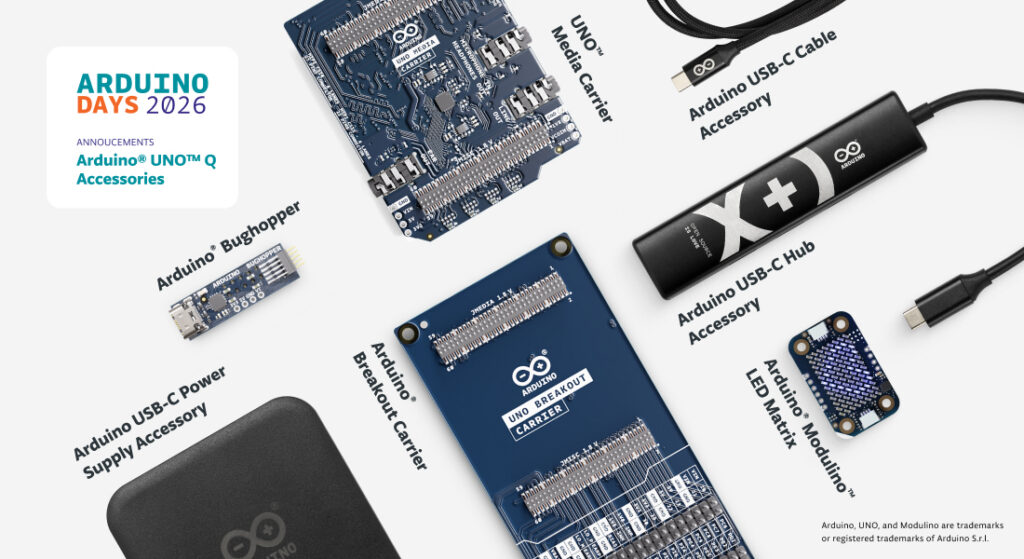
Arduino Days is a great moment to celebrate our community – and what better way to party than with a new product… or seven!
During the first day of the event, our team took turns to introduce a variety of accessories and compatible boards you can use in combination with UNO Q and many other elements in our ecosystem, to expand capabilities and make your life easier as an innovator, educator or tech enthusiast.
Here’s a quick recap of everything we have going on!
Official Arduino power and interface accessories
Unlock the full potential of UNO Q with stable power delivery and expanded physical interfaces.
Official accessories keep your projects running reliably while giving you the ports and connections needed for displays, peripherals, and storage – enabling a complete, ready-to-use single board computer experience straight out of the box!
We’ve thoroughly tested a set of key accessories to guarantee you a frictionless experience down to every detail:
- Arduino USB-C Power Supply (45W): A 45 W multi-plug designed for compatibility with multiple countries, delivering stable, regulated power for demanding workloads.
- Arduino USB-C Cable (24 pin): A 24 pin, high-speed data and power cable that provides a single durable, reliable connection.
- Arduino USB-C Hub (8 in 1): A hub purpose-built to transform UNO Q into a fully connected single board computer – adding HDMI, Ethernet, multiple USB ports, and power passthrough with one compact solution.
Arduino® UNO Media Carrier
Extend the multimedia capabilities of UNO Q by enabling advanced vision, display, and audio applications with plug-and-play simplicity.
UNO Media Carrier is designed for easy integration: it connects through JMEDIA and JMISC high-speed connectors – both passthrough, to keep all pins available for additional modules or carriers.
Equipped with two MIPI CSI connectors for standard 22-pin MIPI CSI 4 lanes cameras (like Raspberry Pi® cameras), it opens the door to dual-camera computer vision projects, from stereo depth mapping to multi-angle image capture. A MIPI DSI interface provides compatibility with 22-pin 4 lanes MIPI DSI displays, making it easy to add rich, interactive visual output to your projects without additional adapters.
For audio, UNO Media Carrier includes three dedicated 3.5 mm jacks: one combined microphone input and headphone output for flexible audio capture and monitoring, one line out for connecting to amplifiers or powered speakers, and one ear out enabling Class-AB differential earpiece output.
Together, these interfaces turn your UNO Q into a complete edge multimedia hub, ideal for AI-powered kiosks, object tracking, interactive installations, and more.
Arduino® UNO Breakout Carrier
Whether in the lab or the field, UNO Breakout Carrier facilitates hardware accessibility, simplifies troubleshooting, and opens up the full potential of UNO Q advanced interfaces.
Gain complete, direct access to relevant signals available on UNO Q JMEDIA and JMISC high-speed connectors. Ideal for advanced prototyping, testing, and integration work, UNO Breakout Carrier exposes audio, I²C, SPI, UART, PWM, power rails, and control signals to clearly labeled, easy-to-use breakout headers.
With relevant pins brought out to standard, accessible male header connectors, you can connect UNO Q to custom circuits, measurement equipment, or third-party modules without complex adapters or soldering. This carrier is particularly valuable for debugging hardware interfaces, verifying signal integrity, or integrating UNO Q into larger embedded systems where direct wiring access is required.
Arduino® Bug Hopper
Simplify debug access and keep your UNO Q projects running smoothly!
Arduino Bug Hopper is a compact board designed to bring straightforward remote debugging to UNO Q via its JCTL connector. Built around the FT230XQ-R FTDI USB-to-UART bridge, it provides a reliable, high-speed serial link between your development machine and UNO Q, enabling advanced debugging and logging without occupying your main I/O.
Its compact 38.5 × 11 mm footprint makes it easy to integrate into any workspace or enclosure, a USB-C connector enables direct cable attachment, and a male 1.27 mm 2×5 header can be used for compact ribbon cable setups. In addition, onboard LEDs clearly indicate the status of 5 V, 3.3 V, and VTARGET power rails at a glance.
Arduino® Modulino LED Matrix
Add a visual display for your brightest ideas – it’s easy with the newest modular, versatile, plug-and-play Modulino!
Modulino nodes are tiny, function-specific sensors and actuators that you can plug into your project to quickly add functionalities. They connect via Qwiic to compatible boards like Arduino® Nano R4 and UNO Q, and daisy chain effortlessly – so you can prototype, learn, and build quickly.
There are 11 Modulino nodes already out, and now we are adding #12 to the family: meet Modulino LED Matrix. Use its 8×12 LED matrix to show off light animations, feedback, notifications and more.
Keep an eye out for each new addition!
We were too excited about this haul of new products not to share with you during Arduino Days! Modulino LED Matrix is already available from the Arduino Store; the others will roll out soon – make sure to follow us on social media or sign up for our newsletter to know when you can get your hands on them!
Arduino, UNO, Modulino, and Nano are trademarks or registered trademarks of Arduino S.r.l.
The post We just announced SEVEN new products, ready to expand your Arduino® UNO™ Q board appeared first on Arduino Blog.
Read more here: https://blog.arduino.cc/2026/03/27/we-just-announced-seven-new-products-ready-to-expand-your-arduino-uno-q-board/