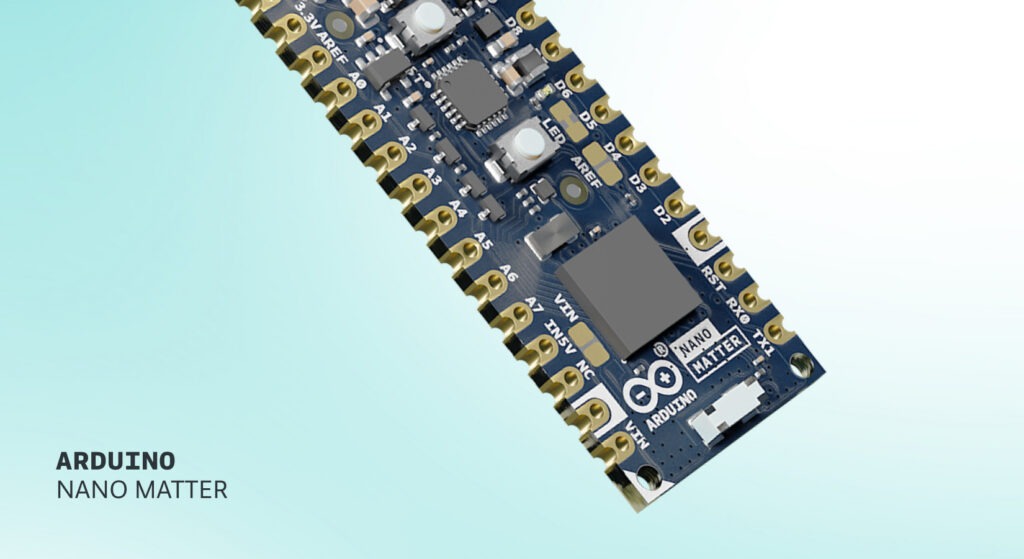
The Arduino® Nano Matter board just gained a second life. It now has an official upstream Zephyr RTOS board definition – making it a first-class professional embedded development platform alongside everything it already does with the Arduino® IDE.
That means you can type west build -b arduino_nano_matter, pick any Zephyr sample, and build production-grade firmware with Bluetooth® LE 5.3 wireless technology, real-time multitasking, and hardware security – all on the same cost-effective board you already know. And with its compact 45 x 18 mm castellated-pad design, Nano Matter is a board you can take from prototype to production – literally embedding it in your end-product.
What is native Zephyr?
Zephyr RTOS is an embedded platform backed by the Linux Foundation with Platinum members including Google, Intel, Meta, NXP, Nordic, and Silicon Labs. With 900+ supported boards, 1,100 unique contributors in 2024, and its 10th anniversary in 2026, Zephyr has become the fastest-growing RTOS ecosystem for professional embedded development.
“Native Zephyr board support” means Nano Matter has an official board definition inside the Zephyr source tree at boards/arduino/nano_matter/. When you run west build -b arduino_nano_matter, the build system knows exactly how to target your board – which pins, which peripherals, which radio stacks. This is the standard professional workflow used by companies shipping commercial IoT products.
A quick note: This is separate from ArduinoCore-zephyr, which brings the Arduino® API on top of a Zephyr backend for the Arduino IDE. Native Zephyr means the full Zephyr API, Devicetree, Kconfig, and the complete RTOS toolchain – no framework translation layer.
Two paths, one board
What makes Nano Matter special is that it serves two development worlds on one board:
- Arduino® Core path: Build Matter-over-Thread smart home devices and BLE applications using the Arduino IDE. Quick prototyping, familiar API, massive community. With Matter adoption accelerating across the smart home industry and over a thousand certified Matter products already on the market, this path puts you at the center of the connected home.
- Native Zephyr path: Build professional BLE firmware with a full RTOS, multi-threading, advanced power management, and production-grade toolchain. Arduino Nano Matter’s native Zephyr support is backed by Silicon Labs (Platinum Zephyr member) and Arduino (Silver Zephyr member), as part of the growing Zephyr Project ecosystem. This is what this article is about.
You choose which path fits your project. The board supports both. For teams, this means a single hardware investment serves prototyping through production, across skill levels and project types.
From prototype to production
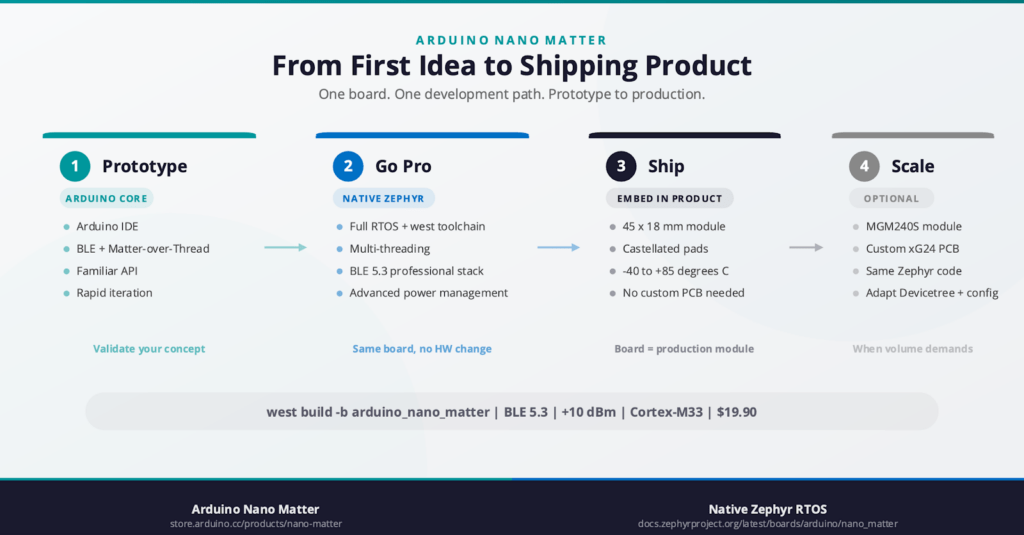
Here is where Nano Matter changes the game. At 45 x 18 mm with castellated pads, integrating the wireless SoC, antenna, power regulation, USB-C, and debug interface, the board is designed to be embedded directly in end-products.
The path looks like this:
- Prototype your idea on Nano Matter using Arduino Core. Validate your concept fast with the familiar Arduino IDE, BLE, and Matter-over-Thread support.
- Go professional – when your product requirements grow beyond what the Arduino framework offers, switch to native Zephyr on the same board. Full RTOS, multi-threading, advanced power management, production-grade toolchain. No hardware change needed.
- Ship initial production units with Nano Matter soldered directly into your product. The operating temperature range (-40 to +85 °C) and Secure Vault hardware security mean it is ready for real-world conditions.
- Scale when volumes justify it. Move to a bare MGM240S module or custom PCB – your Zephyr firmware retargets with minimal changes.
One board carries you from first idea to shipping product. IoT product development timelines continue to stretch as regulations and complexity grow. A unified platform that covers prototyping through production on the same hardware helps compress that timeline significantly.
For hardware startups shipping their first 100-1,000 units, small-batch industrial products, and research devices deployed in the field – this means skipping months of custom PCB design and RF certification for initial production, with a clear migration path when volume demands it.
Key capabilities at a glance
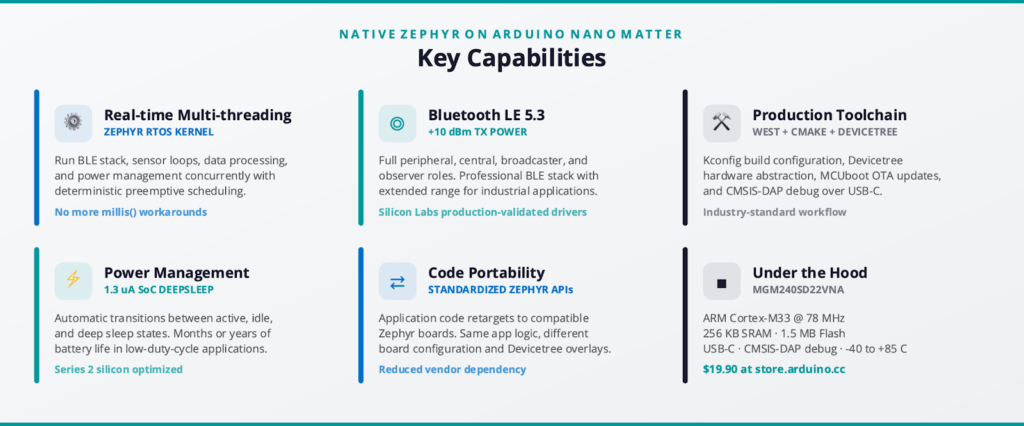
Native Zephyr on Nano Matter unlocks:
- Real-time multi-threading – Run BLE stack, sensor loops, data processing, and power management concurrently with deterministic scheduling. No more millis() workarounds.
- Advanced power management – Automatic transitions between active, idle, and deep sleep states. The Silicon Labs MGM240S SoC achieves 1.3 uA in EM2 DeepSleep mode (16 kB RAM retention, LFRCO).
- BLE 5.3 – Full peripheral, central, broadcaster, and observer roles. +10 dBm TX power for extended range.
- Hardware security – Silicon Labs Secure Vault (PSA Certified Level 3) – hardware root of trust, secure key storage, and secure boot built into the silicon. Hardware-accelerated crypto available through the Simplicity SDK for Zephyr. Critical for EU Cyber Resilience Act compliance, with the vulnerability reporting deadline on September 11, 2026 and fines up to 15M euro or 2.5% of global turnover.
- Code portability – Zephyr’s standardized APIs mean your application code retargets to other Zephyr-supported boards with compatible peripherals. Moving from Nano Matter to a bare MGM240S module requires minimal board configuration. Retargeting to a different BLE-capable Zephyr board means adapting Devicetree overlays and pin mappings, but your application logic stays the same.
- Long-term maintainability – Standardized APIs, Devicetree hardware abstraction, and Kconfig configuration create firmware that is structured, testable, and maintainable across product lifecycles.
Under the hood: ARM Cortex-M33 at 78 MHz, 256 KB SRAM, 1.5 MB flash – plenty of room for sophisticated applications.
Getting started in four simple steps
1. Set up your workspace
west init ~/zephyrproject
cd ~/zephyrproject
west update
2. Build
west build -b arduino_nano_matter samples/basic/blinky
3. Flash
west flash
4. Go further
west build -b arduino_nano_matter samples/bluetooth/beacon
west build -b arduino_nano_matter samples/bluetooth/peripheral_hr
No external programmer needed – the board’s built-in CMSIS-DAP debugger handles everything over USB-C. Full details in the Zephyr Getting Started Guide.
Get started today!
Nano Matter is available now at the Arduino Store. You can explore the official Zephyr board documentation to dive deeper into its capabilities, follow the Zephyr Getting Started guide for step-by-step setup instructions, and connect with other developers in the Zephyr Discord community to exchange ideas, get support, and accelerate your development journey.
Whether you are building your first BLE project, prototyping a product you plan to ship, or looking for a professional development platform on accessible hardware, Nano Matter with native Zephyr takes you from idea to production on a single board.
Sources
- matter-smarthome.de, “The Matter Standard in 2026 – A Status Review,” January 2026. Link
- Zephyr Project, “2024 Wrap-Up: A Year of Growth, Innovation and Community Impact,” January 2025. Link
- Embedded Computing Design, “Zephyr Project Grows Membership, Highlights Security and Resilience at embedded world 2026,” February 2026. Link
- Silicon Labs, “Silicon Labs Extends IoT Security Leadership with World’s First PSA Level 4 Certification,” August 2025. Link
- Silicon Labs, MGM240SD22VNA Product Page. Link
- Keysight, “One Year Countdown to EU CRA Compliance: September 11, 2026,” September 2025. Link
Arduino and Nano are trademarks or registered trademarks of Arduino S.r.l.
The post Your Arduino Nano Matter board is now a professional Zephyr development platform appeared first on Arduino Blog.
Read more here: https://blog.arduino.cc/2026/03/10/your-arduino-nano-matter-board-is-now-a-professional-zephyr-development-platform/